Performing wudu is a crucial Islamic practice that purifies both the body and the soul, preparing the individual for prayer. Knowing how to perform wudu correctly ensures proper spiritual preparation and fulfills religious obligations. This guide from Riyad Alquran includes an understanding of what wudu is in Islam, its spiritual benefits, the correct step-by-step method, common mistakes to avoid, what invalidates wudu, special rules for women, and when to perform dry ablution (tayammum).This guide provides everything a Muslim needs to understand how to perform wudu in a complete and correct way.
What is Wudu (Ablution) in Islam and Why is it Essential?
Wudu (ablution) is the sacred Islamic act of purification, involving the washing of specific body parts to achieve spiritual and physical cleanliness. It is a fundamental prerequisite for acts of worship, primarily Salah (prayer). Learning how to perform wudu correctly is essential for every Muslim, as it directly impacts the validity of one’s prayer.
Its Definition & Components:
· A Ritual Cleansing: It follows a precise, ordained sequence of certain parts of the body which is an essential part of understanding how to perform wudu in the correct Islamic manner.
· Washed Parts: Includes the hands, mouth, nose, face, arms, and the ritual wiping of the head and washing of the feet.
· A State of Minor Purity: It is distinct from Ghusl (major ritual bath) and Tayammum (dry ablution).
Core Importance:
· Mandatory for Prayer: Valid Salah cannot be performed without it.
· Spiritual Renewal: It symbolizes the washing away of minor sins and fosters a state of readiness for worship.
· Mental Preparation: It creates a focused and mindful transition into worship.
In essence, Wudu is a profound spiritual practice that seamlessly integrates physical purification with inner readiness to stand before Allah. Understanding how to perform Wudu helps ensure that every act of purification is done according to the Islamic guidelines.
Spiritual Benefits of Wudu and The Command from Allah
Wudu (ablution) is a fundamental Islamic obligation commanded by Allah in the Qur’an (Al-Ma’idah:6) to purify a Muslim both physically and spiritually before prayer. It is not merely washing the limbs; rather, it is a complete gateway to worship that washes away sins, purifies the heart, deepens concentration in prayer, instills inner tranquility, strengthens one’s connection with Allah, and embodies complete submission to His will.
First: The Direct Divine Command
The noble verse states: “O you who have believed, when you rise to [perform] prayer, wash your faces and your forearms to the elbows and wipe over your heads and wash your feet to the ankles…” (5:6) . This is a clear Quranic foundation that makes wudu a divine condition without which prayer is not accepted.
Second: The Multiple Spiritual and Psychological Benefits
· Purification from Sins: With every washed limb, its minor sins are forgiven, renewing the heart’s purity and faith.
· Deep Spiritual Connection: It prepares the heart and mind for complete communion with Allah in prayer, elevating one’s spiritual state.
· Inner Peace and Emotional Regulation: It acts as a “spiritual reset” that calms the soul and helps control anger.
· A Symbol of Submission and Compliance: It is a practical act of obedience that translates submission to Allah and draws the servant closer to the Creator.
· Discipline and Mental Mindfulness: It cultivates daily discipline and transforms a routine act into a sacred, conscious experience.
· Angelic Blessings: Performing wudu while already in a state of purity is recommended, as the angels pray for the forgiveness of the one who performs it.
· Preparation for Prayer (Salah): It is the essential gateway to the reverence and presence of the heart in prayer.
Therefore, mastering how to perform wudu step by step and understanding these meanings is the key to appreciating the grandeur of this act of worship and fully reaping its fruits in daily life.
These spiritual meanings become clearer when a Muslim understands how to perform wudu with presence and sincerity.
Step-by-Step Guide: How to Perform Wudu Correctly
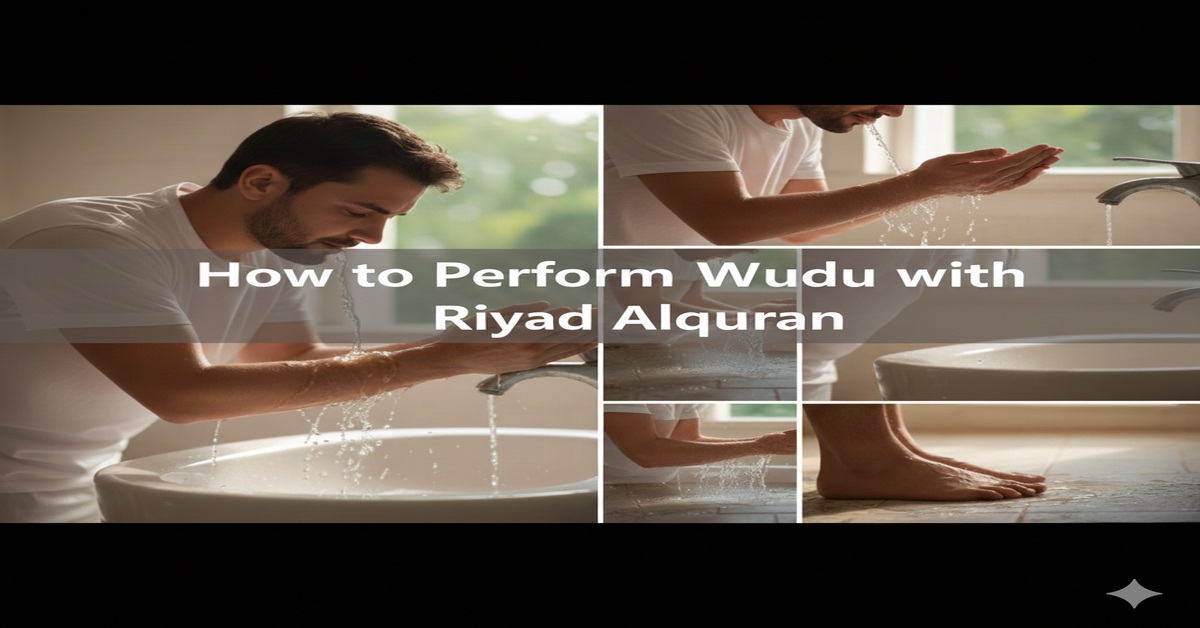
To ensure your Wudu is valid, you must carefully follow each step in the proper order. This process begins with a sincere intention and ends with a supplication, covering all prescribed body parts. Below is the detailed method for how to perform Wudu correctly, ensuring every obligatory and recommended action is fulfilled.
Steps for Wudu (Ablution)
1. Intention & Declaration
Silently make the intention (Niyyah) in your heart to perform Wudu for the sake of Allah. Then, verbally begin by saying “Bismillah” (In the name of Allah).
2. Wash the Hands
Wash both hands up to the wrists thoroughly three times, ensuring water reaches between the fingers.
3. Rinse the Mouth
Using your right hand, take water and rinse your mouth vigorously three times, then spit the water out.
4. Clean the Nose
Sniff water into your nostrils with your right hand and then expel it with your left hand. Repeat this three times.
5. Wash the Face
Wash your entire face from the hairline to the chin and from ear to ear three times. If you have a beard, run wet fingers through it to ensure the skin underneath is moistened.
6. Wash the Arms
Wash your right arm from the fingertips to and including the elbow three times. Repeat the same process for the left arm.
7. Wipe the Head
With wet hands, wipe your entire head once. This is done by moving your hands from the front of the head to the back, then back to the front.
8. Wipe the Ears
Using your index fingers, wipe the inside ridges of your ears. Simultaneously, use your thumbs to wipe the backs of your ears. This is done once.
9. Wash the Feet
Wash your right foot up to and including the ankle three times, ensuring water reaches between the toes. Repeat the same for the left foot.
10. Final Supplication
Upon completion, recite the recommended prayer (Shahada and Dua) to seal the act of worship. Following these steps is essential for anyone seeking to learn how to perform wudu correctly and completely.
Key Principles for Valid Wudu
· Order (Tartib): The steps must be performed in the exact sequence listed above.
· Continuity (Muwalat): There should be no significant delays between washing each part; the actions should follow consecutively.
· Thoroughness: You must ensure water covers the entire specified area of each limb without leaving any part dry.
By meticulously following this guide on how to perform Wudu in islam, you fulfill both the obligatory acts (Fard) and the Prophetic traditions (Sunnah), achieving a state of complete ritual purity.
Common Mistakes to Avoid While Doing Wudu
Understanding how to perform wudu correctly involves more than just knowing the steps; it requires avoiding common pitfalls that can compromise the validity of your ablution.
Common Wudu Mistakes and How to Correct Them
1. Incomplete Washing of Limbs
· Mistake: Washing only up to the wrists or the upper feet, stopping short of the elbows and ankles as mandated.
· Correction: Ensure water flows completely from the fingertips to above the elbows and from the toes to above the ankles, paying specific attention to often-missed areas like the heels.
2. Leaving Dry Spots
· Mistake: Water failing to reach the skin beneath thick beards, between fingers, or between toes.
· Correction: Run wet fingers thoroughly through the beard. When washing hands and feet, actively spread fingers and toes apart to allow water to contact all skin surfaces.
3. Superficial Mouth and Nose Rinsing
· Mistake: A quick, ineffective rinse that does not properly clean the mouth and nasal passages.
· Correction: Swish water vigorously throughout the mouth three times. For the nose, use the right hand to sniff water deep into the nostrils and then expel it completely with the left hand.
4. Rushing and Lack of Focus
· Mistake: Performing wudu hastily, engaging in conversation, or allowing the mind to wander, which diminishes its spiritual essence.
· Correction: Approach wudu with presence of mind (khushu’). Perform each step deliberately and with mindfulness, remembering it is an act of worship.
5. Wiping Over Obstructions
· Mistake: Wiping over shirt sleeves, socks, or a watch instead of washing the skin directly, without a valid excuse.
· Correction: Remove any removable barriers (roll up sleeves, remove watches). Direct water must reach the skin. Wiping is only permissible over a permanent cast or bandage covering a wound.
6. Using Excessive Water
· Mistake: Letting water run wastefully, contrary to the Prophetic example of conservation.
· Correction: Be moderate, Use a container or cup to control the amount of water, using only what is necessary to cover each limb thoroughly.
7. Disregarding Sequence and Intention
· Mistake: Mixing up the order of steps (e.g., washing feet before wiping the head) or letting the initial conscious intention (niyyah) fade.
· Correction: Strictly follow the divine sequence: face, arms, head (including the masah), then feet. Maintain awareness of your intention to perform wudu for the sake of Allah from start to finish.
By diligently correcting these common errors, you transform how to perform fard wudu from a routine act into a complete, accepted, and spiritually fulfilling purification.
What Breaks Wudu? (Things That Nullify Ablution)
To correctly understand how to perform wudu, one must know the actions that nullify it. Wudu is primarily broken by natural bodily excretions (urine, feces, gas, heavy bleeding or vomiting), loss of consciousness (through deep sleep, fainting, or being drunk), and according to some scholarly views touching the private parts or eating camel meat. These incidents require one to renew their wudu before prayer or handling the Quran.
Major Nullifiers (Consensus)
· Natural Excretions: Releasing urine, feces, or gas (if audible or smelled).
· Loss of Consciousness: Deep sleep (where one is unaware), fainting, or intoxication.
· Sexual Activity: Sexual intercourse or the emission of semen/vaginal fluid, which requires Ghusl (the full ritual bath).
Differing Views (Madhabs)
. Vomiting: Vomiting a mouthful or more (in some scholarly opinions).
· Bleeding: Light bleeding (e.g., from a wound or nosebleed) may not break wudu in some schools (like the Hanafi if it does not flow) but does in others.
· Touching: Touching the private parts directly with the bare hand is an action that requires renewal of wudu according to many scholars, based on their understanding of the Prophetic guidance. It is a recommended practice to be on the safe side (the path of caution) in matters of worship.
· Eating Camel Meat: Out of an abundance of caution, some scholars also recommend renewing wudu after eating the meat of a camel, following a well-known Prophetic tradition.
· Washing the Dead: Some teachings hold that washing a deceased person requires renewing one’s wudu or performing Ghusl.
What Does Not Break Wudu (Generally)
· Doubt: Merely doubting your wudu after completing it does not break it; such doubts should be ignored.
· Light Touching of wife: Simply touching one’s spouse does not break wudu for most scholars, as the relevant Quranic verse pertains to sexual relations.
Important Clarification
Egypt’s Dar Al-Ifta emphasizes that najasa (physical impurity) on the body invalidates the prayer itself, not necessarily the wudu. It also confirms that unwarranted doubts after performing wudu should be disregarded. For specific personal cases, consulting a recognized religious authority like Egypt’s Dar Al-Ifta is recommended. Mastering these rules is a key part of learning how to perform wudu properly for valid worship.
Wudu Rules for Women and Girls
Learning how to perform wudu for females follows the same fundamental rules as for men, involving washing the hands, mouth, nose, face, arms, wiping the head and ears, and washing the feet. However, when explaining how to perform wudu for women, it is essential to emphasize the importance of first removing makeup and nail polish to ensure water touches the skin directly. Special care must be taken, Move your rings slightly while washing so water can reach the skin underneath them.
Alternatives to Wudu: When to use Tayammum (Dry Ablution)
Tayammum, or dry ablution, is a divinely granted alternative in Islam for achieving ritual purity when using water for how to perform wudu is impossible, harmful, or highly impractical. This concession allows Muslims to fulfill their obligation of prayer using clean earth, sand, or dust when standard water-based purification is not feasible.
When Is Tayammum Performed?
Tayammum becomes permissible or obligatory under specific circumstances:
1. Absolute Water Scarcity: When no clean water is available within a reasonable distance, or the quantity found is insufficient for both purification and essential needs like drinking.
2. Risk of Illness or Injury: If using water would worsen an existing medical condition (e.g., a wound, skin disease, or severe illness) or cause harm, such as in cases of extreme cold where it could lead to sickness.
3. Inaccessibility or Danger: When accessing available water poses a genuine threat to life, security, or property.
4. Critical Water Conservation: When the available water must be reserved for drinking or cooking to sustain life, especially during travel or in arid environments.
5. Imminent Prayer Time: If the time for a time-sensitive prayer (like the funeral prayer or congregational Eid prayer) is so short that fetching water would cause one to miss it entirely.
Key Principles of Performing Tayammum
To ensure its validity, Tayammum must adhere to core principles:
· Sincere Intention (Niyyah): The heart must consciously intend to perform Tayammum for the purpose of prayer.
· Pure Material: It must be performed using ritually clean, natural earth, sand, dust, or stone.
· Correct Procedure: The approved method of how to perform dry wudu involves:
1. Striking the pure earth once with both palms.
2. Shaking or gently blowing off any excess loose particles.
3. Wiping the entire face once with the palms.
4. Striking the earth a second time, then wiping the right hand up to the wrist with the left palm, and the left hand up to the wrist with the right palm.
· Temporary Validity: The state of purity from Tayammum remains in effect only as long as the excuse persists. Once water becomes available and safe to use, or the reason for the concession ends, it becomes obligatory to perform the standard how to perform dry wudu (i.e., regular wudu with water) for subsequent prayers.
Finally, mastering how to perform wudu is a meaningful step in strengthening your faith and spiritual connection. For more inspiring lessons and courses on Quran recitation, Tajweed, and Arabic, be sure to explore Riyad Alquran. Their resources will empower you to grow in knowledge and practice with confidence.
Book Your Free Trial at Riyad Alquran Today!
FAQ
Is there a difference in how to perform wudu for males compared to females?
The core steps and obligations are identical. The main practical consideration for men is ensuring water reaches the skin under a thick beard during the face wash.
The key difference for women is ensuring water reaches the skin by:
1. Removing impermeable nail polish.
2. Wiping the hair/scalp directly, not over a headscarf.
3. Removing thick, waterproof makeup from the face.
Once this is done, the ritual is performed the same way
How do you perform masah on the socks in wudu?
Masah in Wudu involves wiping over your head and/or socks (or shoes) with wet hands as a permissible shortcut instead of washing them. This allows you to perform ablution for longer periods without rewashing your feet.
How to perform it:
For socks/khuff: Use wet fingers to wipe from the toes up to the ankle. Use your right hand for your right foot and your left hand for your left foot, once.
This is done after initially washing your feet in full wudu.
What should I say before and after Wudu?
Begin with “Bismillah” (In the name of Allah).
After:Recite the Shahada and the Dua: “Ashhadu an la ilaha illallah, wahdahu la sharika lah, wa ashhadu anna Muhammadan ‘abduhu wa rasuluh. Allahummaj’alni minat-tawwabeena waj’alni minal mutatahhireen.”
Can I perform Wudu with nail polish on?
No, because water must reach the entire nail. Impermeable nail polish forms a barrier and must be removed before Wudu or Ghusl so, knowing how to perform wudu for women is essential.