
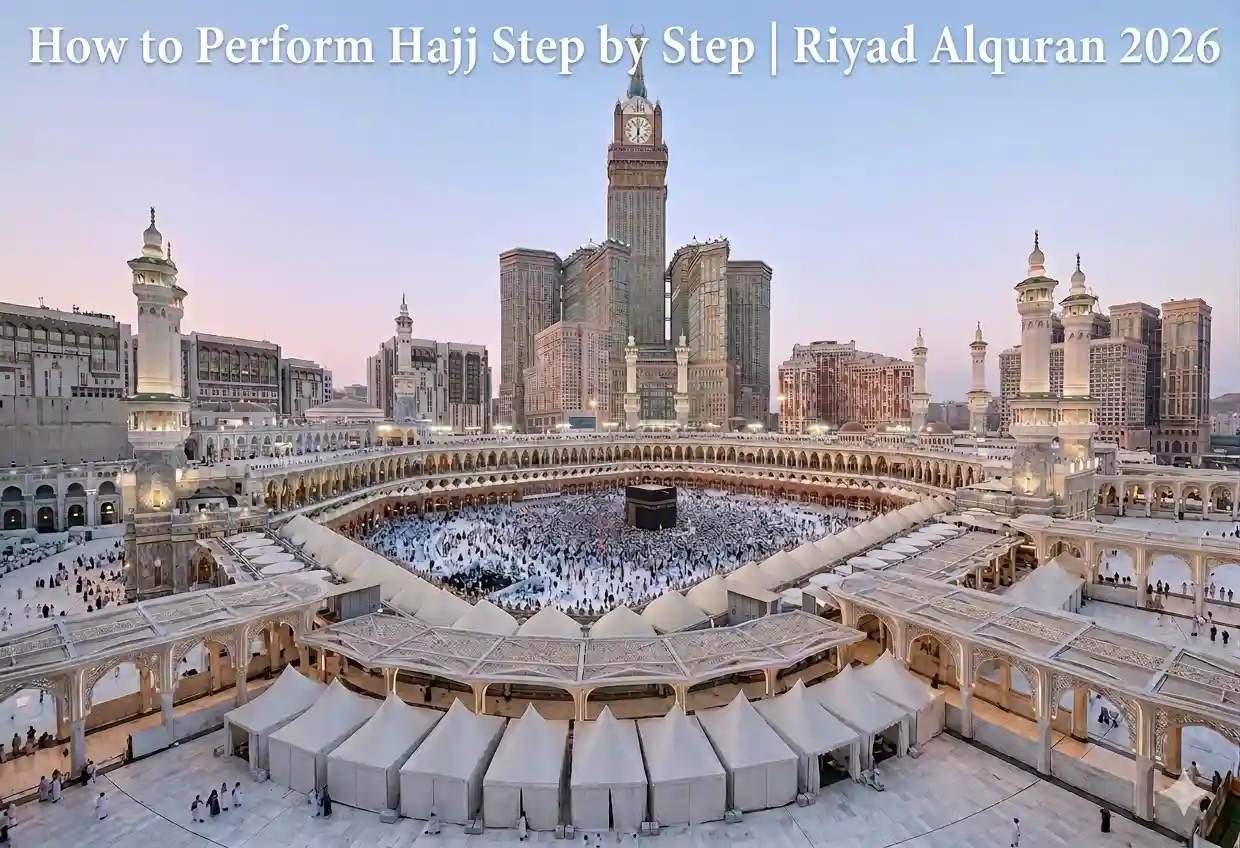
Learning how to perform hajj is a sacred milestone for every Muslim seeking spiritual renewal. As you prepare for the 2026 season, understanding the rituals with precision is essential.
At Riyad Alquran Institute, we bridge the gap between knowledge and practice through expert-led Islamic studies. Follow our comprehensive, step-by-step guide to ensure your pilgrimage is performed correctly, echoing the Sunnah while deepening your lifelong connection to the Divine Words.
Table of Contents
ToggleWhat is Hajj and Why Did Allah Legislate This Sacred Journey?
Hajj in islam represents the sacred journey to Mecca and stands as the fifth pillar of our faith. Learning how to perform hajj is a mandatory obligation for every adult Muslim who is physically and financially capable. This journey is a profound act of devotion that offers spiritual purification and fosters global unity. By following the hajj procedure, pilgrims reenact the historical obedience of Prophet Ibrahim (AS), his wife Hajar, and the final Sunnah of Prophet Muhammad (PBUH).
Why Did Allah Legislate This Sacred Journey?
Allah mandated the performance of hajj for profound spiritual, historical, and personal reasons that transform the believer’s soul:
- Absolute Submission to Allah: It is an act of total surrender. Millions gather to worship Allah alone, renouncing worldly distinctions of status and wealth.
- Purification and Forgiveness: The Prophet Muhammad (PBUH) stated that whoever completes the hajj pilgrimage rituals properly “will go back [free of sin] as his mother bore him.”
- Commemoration of Prophetic History: The rituals, such as running between Safa and Marwa and stoning the pillars, directly honor the sacrifices of Prophet Ibrahim (AS) and his family.
- Symbol of Equality and Unity: By wearing the simple Ihram, all Muslims, regardless of nationality stand equal before their Creator.
- Preparation for the Afterlife: The assembly of humanity during the muslim pilgrimage serves as a powerful reminder of the Day of Judgment.
Detailed Schedule on How to Perform Hajj in 2026
To ensure a valid hajj performance, you must be aware of the specific timing and locations required for the 2026 season:
- When: The rites take place annually from the 8th to 13th of Dhul-Hijjah. For Hajj 2026, this is expected to fall in late May.
- Where: The journey centers around Mecca and the nearby holy sites of Mina, Arafat, and Muzdalifah.
- What: The hajj ritual steps include donning the Ihram, the pivotal day of repentance at Arafat, staying overnight in Muzdalifah, the stoning of the devil, and the final farewell Tawaf.
The Virtues of Hajj: Reward of Paradise and Forgiveness of Sins
Performing Hajj islam is a spiritual milestone that offers rewards beyond imagination. According to the teachings of Prophet Muhammad (PBUH), this sacred journey transforms the believer in several ways:
- Total Forgiveness of Sins: When you learn how to perform hajj without engaging in immoral acts, disobedience, or arguments, you return home as pure as a newborn child.
- The Guarantee of Paradise: A sincere and accepted pilgrimage, known as Hajj Mabrur, has no reward other than Paradise.
- Elimination of Poverty: Performing Hajj and Umrah consecutively removes poverty and sins, just as a blacksmith’s bellows remove impurities from iron, gold, and silver.
- A Superior Form of Jihad: For women, completing a sincere mecca pilgrimage is considered a superior form of Jihad (striving in Allah’s cause).
- Spiritual Transformation: The journey fosters deep humility and a detachment from worldly desires, creating a stronger longing for the afterlife.
- Symbol of Equality: In the state of Ihram, all pilgrims wear identical white garments, proving that all Muslims are equal regardless of their wealth or status.
Understanding the spiritual rewards is just as important as knowing how to perform hajj with physical precision.
What is Hajj Mabrur?
It is an “accepted Hajj” performed with total sincerity and without showing off. To achieve this, a pilgrim must strictly follow Islamic teachings while avoiding obscenity and conflicts throughout the journey.
Hajj 2026 Dates: The Expected 6-Day Schedule
If you are planning your journey, Hajj 2026 is expected to take place from May 25 to May 30, 2026. The most important day, the Day of Arafah, is anticipated on Tuesday, May 26, while Eid al-Adha should fall on Wednesday, May 27.These dates are subject to moon sighting in Saudi Arabia and may vary by a day.
To ensure a valid pilgrimage, you must follow the hajj rituals day by day during these six sacred days:
Day 1: Day of Tarwiyah (8th of Dhul-Hijjah)
- Assuming Ihram: For those performing Tamattu’ Hajj, take a bath (Ghusl), wear the Ihram clothes, and make the intention for Hajj from your location in Mecca.
- Heading to Mina: Pilgrims head to Mina before Dhuhr prayer.
- Prayers: Perform Dhuhr, Asr, Maghrib, Isha, and Fajr (of the next day) in Mina, shortening the four-unit prayers to two units without combining them.
- Staying Overnight: It is Sunnah to spend the night in Mina.
Day 2: Day of Arafah (9th of Dhul-Hijjah)
- Heading to Arafat: After sunrise, move towards Mount Arafat.
- The Pillar of Hajj: This is the most important day. Stay within the boundaries of Arafat until sunset.
- Prayers: Perform Dhuhr and Asr combined and shortened (Jam’ and Qasr) during the time of Dhuhr.
- Devotion: Spend the time in Dhikr (remembrance), Istighfar (seeking forgiveness), and sincere Dua (supplication).
- Muzdalifah (Night of the 10th): After sunset, depart for Muzdalifah. Perform Maghrib and Isha combined (Isha shortened) upon arrival. Collect pebbles for stoning.
Day 3: Day of Nahr / Eid Al-Adha (10th of Dhul-Hijjah)
- Stoning Jamrat al-Aqaba: Head to Mina and throw 7 pebbles at the largest pillar (Jamrat al-Aqaba), saying “Allahu Akbar” with each throw.
- Sacrifice (Hady): For those performing Tamattu’ or Qiran, a sacrifice is offered.
- Shaving/Cutting Hair: Men shave or trim their hair, and women cut a small portion. This is the First Partial De-consecration (At-Tahallul al-Asghar); you can now wear regular clothes.
- Tawaf al-Ifadah: Head to the Kaaba in Mecca to perform the obligatory Tawaf and Sa’i (if not already done). This completes the Full De-consecration (At-Tahallul al-Akbar).
Day 4: First Day of Tashreeq (11th of Dhul-Hijjah)
- Staying in Mina: Spend the day and night in Mina.
- Stoning the Three Pillars: After the sun reaches its zenith (Zawal), stone all three pillars (Small, Medium, and Large) in order, using 7 pebbles for each (21 total).
- Dua: It is Sunnah to make long supplications after stoning the small and medium pillars.
Day 5: Second Day of Tashreeq (12th of Dhul-Hijjah)
- Stoning: Repeat the stoning process for all three pillars (21 pebbles) after Zawal.
- Nafir al-Awwal (Early Departure): If you wish to leave early, you must depart from Mina before sunset. If sunset occurs while you are still in Mina, you must stay for the next day.
Day 6: Third Day of Tashreeq (13th of Dhul-Hijjah)
- Final Stoning: For those who stayed (the “Late Departures”), stone the three pillars after Zawal with 21 pebbles.
- Conclusion: Leave Mina for Mecca.
- Tawaf al-Wada’ (Farewell Tawaf): Before leaving Mecca to return home, perform the final Farewell Tawaf as your last act at the Kaaba.
Hajj Tamattu, Qiran, or Ifrad: Which One Should You Choose?
There are three different ways to fulfill your obligation, and choosing the right one is the first step in your journey. Before you start, you must decide which of the three methods you will follow. Knowing how to perform hajj correctly depends on your location and how long you want to stay in the state of Ihram.
1. Hajj Tamattu’ (Most Recommended):
- How it works: You perform Umrah specifically during the months of Hajj (Shawwal, Dhul-Qi’dah, and the first days of Dhul-Hijjah). After Umrah, you break your Ihram to rest and then enter a new Ihram for Hajj on the 8th of Dhul-Hijjah.
- Best for: International pilgrims (most Hajj 2026 packages use this for comfort).
- Note: A sacrificial animal (Hady) is mandatory.
2. Hajj Qiran (The Combined):
- How it works: You combine Umrah and Hajj in one single Ihram without any break in between.
- Best for: Those who want to remain in a continuous spiritual state, though it is physically demanding.
- Note: A sacrificial animal (Hady) is mandatory.
3. Hajj Ifrad (Hajj Only):
- How it works: You enter Ihram with the intention of performing Hajj only, without Umrah.
- Who it’s for: It is valid for all Muslims, but it is often the preferred choice for local residents of Makkah.
- Note: No sacrificial animal is required for these specific hajj rituals.
Tamattu’ is the most flexible choice because it allows you to change clothes and rest during your pilgrimage to Mecca between Umrah and the start of the main rituals.
The Ultimate Guide: Hajj Rituals Step by Step and Their Sacred Stories
Step 1: Niyyah and Entering Ihram at the Miqat
The journey of how to perform hajj begins with a pure intention (Niyyah). Before reaching Makkah, pilgrims stop at the Miqat to enter the state of Ihram. For men, this means wearing two white, unstitched cloths, while women wear modest clothing. This uniform strips away all worldly adornments, showing that all Muslims are equal before Allah, regardless of wealth or status.
Step 2: Arrival in Makkah – Tawaf and the Story of Zamzam
Upon arriving at the Kaaba, pilgrims perform Tawaf (circumambulating seven times). This is a time for deep prayer and praise. After Tawaf, pilgrims drink from the Zamzam well. This miraculous water first gushed out thousands of years ago under the feet of baby Ismail (PBUH) while his mother, Hagar, was searching for water in the barren desert. To this day, it remains a symbol of Allah’s mercy.
Step 3: Sa’i Between Safa and Marwa: Honoring Hagar’s Legacy
This hajj performance continues with Sa’i, where pilgrims walk seven times between the hills of Safa and Marwa. This rite honors the strength of an Egyptian woman, Hagar, who ran between these hills seven times seeking help. Her faith that Allah “would never lose them” is the heart of this ritual, teaching every pilgrim the power of trust in God.
Step 4: Heading to Mina – The Day of Tarwiyah (8th Dhul Hijjah)
On the 8th of Dhul Hijjah, pilgrims travel to the tent city of Mina. This marks the beginning of the rituals of hajj in the desert. They spend the day and night in prayer (Dhuhr, Asr, Maghrib, Isha, and Fajr), preparing their souls for the greatest day of the entire pilgrimage.
Step 5: Wuquf at Arafat – The Greatest Pillar of Hajj
On the 9th day, the most crucial part of any ritual hajj takes place: Standing at Arafat. From noon until sunset, pilgrims stand in sincere supplication and repentance. Prophet Muhammad (PBUH) said, “Hajj is Arafah,” meaning that without this day, the pilgrimage is not complete.
Step 6: Muzdalifah – Collecting Pebbles for the Stoning Rites
After sunset at Arafat, pilgrims move to Muzdalifah. Here, they pray Maghrib and Isha are combined and sleep under the open sky. During the night, they collect small pebbles that will be used in the upcoming days to stone the pillars in Mina.
Step 7: Ramy al-Jamarat: The Story of Prophet Ibrahim and Satan
Pilgrims return to Mina to perform the stoning ritual (Ramy). This act commemorates the moment Satan tried to whisper to Prophet Ibrahim (PBUH) to disobey Allah’s command. Ibrahim threw stones at Satan to drive him away. By stoning the pillars, pilgrims symbolically reject evil and the whispers of the devil in their own lives.
Step 8: Sacrifice (Nahr) and the Origins of Eid al-Adha
Following the stoning, pilgrims perform the sacrifice (Qurbani). This honors the story of how Ibrahim (PBUH) was ready to sacrifice his son Ismail out of obedience, only for Allah to ransom the boy with a ram. This action is central to the hajj meaning, as it marks the beginning of Eid al-Adha, a global celebration of sacrifice.
Step 9: Tawaf al-Ifadah and the Final Farewell (Tawafthe al-Wadaa)
Finally, pilgrims return to Makkah for Tawaf al-Ifadah and then a final Farewell Tawaf before leaving. This completes the seven steps of hajj for many, marking the end of a life-changing journey and leaving the pilgrim as pure as the day they were born.
To ensure your pilgrimage follows the official regulations and spiritual guidelines, we recommend referring to the Nusuk Gateway, managed by the Ministry of Hajj and Umrah.
Common Mistakes to Avoid While Performing Hajj Rituals
To ensure your journey is accepted, it is essential to understand how to perform hajj according to the Sunnah, avoiding innovations or common errors that could affect the validity of your pilgrimage.
1. Mistakes in Ihram and Intent
Many pilgrims fall into the error of crossing the Miqat without entering the state of Ihram or failing to make the Niyyah (intention) correctly. Understanding the hajj definition as a sacred journey of intent is crucial, as violating Ihram restrictions, such as using perfumed products or trimming hair, requires a penalty (Fidya).
2. Errors During Tawaf and Sa’i
A frequent mistake is pushing or fighting others to kiss the Black Stone (Hajar al-Aswad). While kissing it is Sunnah, avoiding harm to fellow Muslims is mandatory. Additionally, shouting Du’a in unison or wiping over the Kaaba walls are not part of the rituals in hajj and should be avoided to maintain the solemnity of the worship.
3. Misconceptions in Stoning (Rami)
Some pilgrims mistakenly treat the Jamarat pillars as the actual Devil, leading them to throw shoes or heavy objects. You must use only small pebbles and ensure they land inside the designated pit. Avoid stoning outside the permitted times or washing the pebbles, as these are not required hajj pilgrimage rituals.
4. Pitfalls at Arafah and Mina
The most serious mistake is leaving the plains of Arafat before sunset on the 9th of Dhul-Hijjah. Also, neglecting to spend the nights in Mina without a valid excuse or focusing on taking photos instead of deep supplication (Du’a) can diminish the spiritual reward of the journey.
Key Advice for a Valid Pilgrimage:
- Educate Yourself: Learn the authentic steps from reliable sources before you travel to avoid any confusion.
- Practice Patience: Avoid crowding; Hajj is a test of character as much as a physical journey.
- Follow the Sunnah: Stick to the authentic guidelines rather than following common cultural practices or innovations.
Conclusion
Completing your journey and knowing how to perform hajj with sincerity is a life-changing achievement. As you return home, let the discipline and devotion of the pilgrimage refine your character. Riyad Alquran Institute is here to support your spiritual growth long after the rituals end.
Join our global community to continue mastering the Quran and Tajweed principles, ensuring the light of Hajj stays in your heart forever.
FAQs
What is Hajj 2026 Packing Checklist?
Your list should prioritize lightweight essentials like unscented toiletries, a sturdy umbrella, and comfortable walking shoes. To focus on how to perform hajj correctly, ensure your garments are breathable, and don’t forget a small bag for your stones and a pocket-sized guide on how to do hajj to keep the steps fresh in your mind. For men, two sets of Ihram are required, while women should pack breathable, modest clothing suitable for the crowded environment in Mina and Arafat.
How long does it take to perform hajj?
The core rituals usually span 6 days, from the 8th to the 13th of Dhul-Hijjah. However, most pilgrims plan a 2 to 3-week trip to include travel and visiting Madinah. Understanding this timeframe is crucial when learning how to perform hajj, as it requires both physical endurance and spiritual patience throughout the week.
What is a Muslim pilgrimage to Mecca?
It is the ultimate journey of faith where millions of believers gather in total equality to worship Allah. Knowing how to perform hajj is a requirement for every capable Muslim, as this pilgrimage is a core part of the hajj islam definition, representing a complete spiritual rebirth and a return to the path of Prophet Ibrahim (PBUH).
When is Hajj 2026?
This sacred season is expected to fall between May 24th and May 29th, 2026. Since the timing is fixed by the lunar calendar, you must be in Makkah during these specific days to learn how to perform hajj properly.
When is the pilgrimage to Mecca?
This major event only takes place once a year during the month of Dhul-Hijjah. Unlike other acts of worship, knowing how to perform hajj means adhering to a strict schedule; you must be present at Arafat on the 9th and in Mina during the days of Tashreeq to ensure your rituals are performed according to the Sunnah.