Perfecting your Quranic recitation is a journey of precision, and mastering Izhar Letters is the first step toward that excellence. Many students struggle with the subtle nuances of Tajweed, but understanding how to clearly pronounce the throat letters is what distinguishes a beginner from a proficient reciter.
At Riyad Alquran, we bridge the gap between complex rules and effortless recitation. Our approach to teaching Izhar Letters focuses on clarity, articulation points (Makharij), and practical application. If you are looking for a structured way to improve your Tajweed and connect more deeply with the words of Allah, this guide is designed specifically for you. Explore the foundational rules of clear manifestation with us and take your first step toward mastery.
What is Izhar in Tajweed?
If you are wondering about the Izhar meaning in the science of recitation, it literally translates to “clear manifestation” or “making something apparent.” In the context of Tajweed, it refers to the distinct and clear pronunciation of the Noon Saakin (نْ) or Tanween (ـًـٍـٌ) when followed by specific letters, without any extra nasalization (Ghunnah).
To master this rule, you must recognize the Izhar Letters, also known as the throat letters (Halqi). When one of these letters appears after a Noon Sakinah or Tanween, the ‘n’ sound must be crisp and articulated fully from its correct origin.
Key Aspects of Izhar:
- Mechanism: The sound is pronounced fully from its articulation point without holding or pausing.
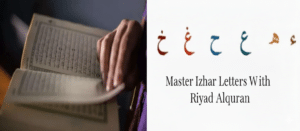
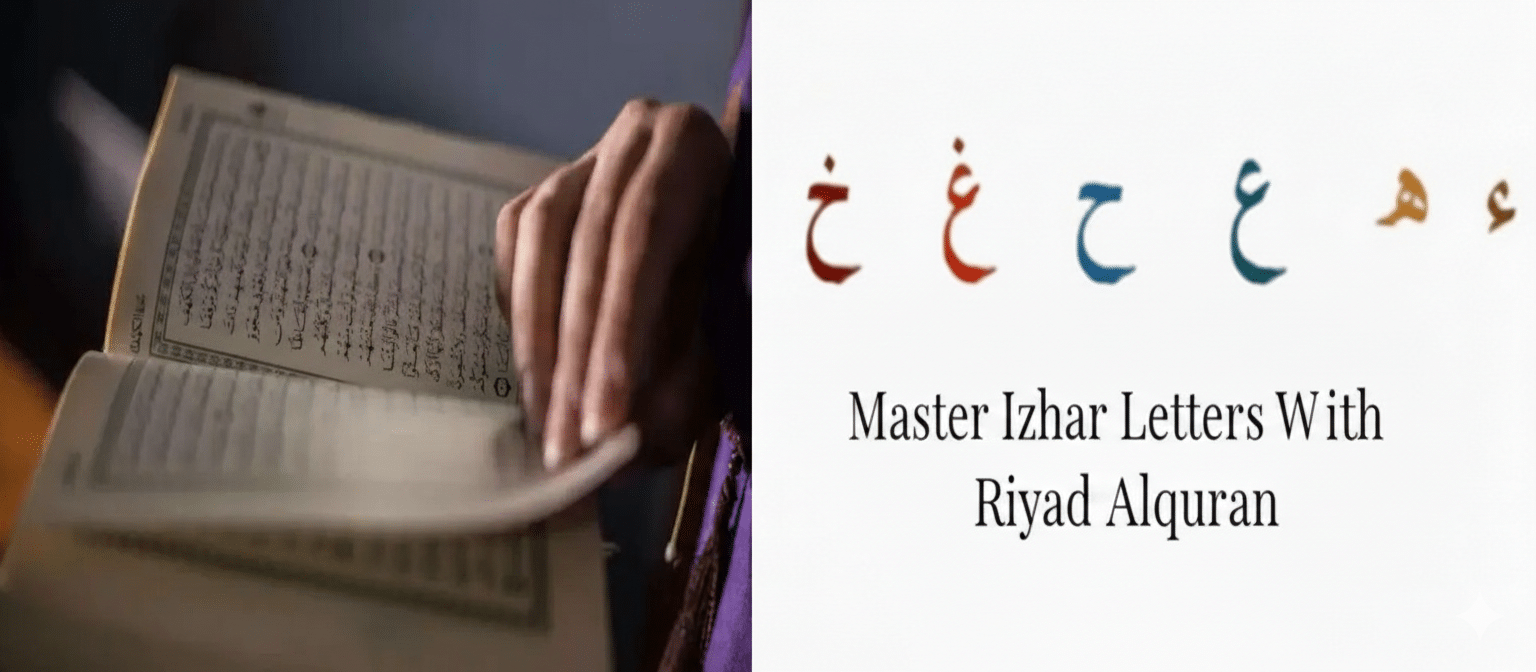
- The 6 Letters (Throat Letters): ء (Hamzah), هـ (Ha), ع (Ayn), ح (Haa), غ (Ghain), خ (Khaa).
Types of Izhar:
- Izhar Halqi (Throat): When a throat letter follows Noon Sakinah or Tanween.
- Izhar Shafawi (Lips): Relating to Meem Sakinah rules (مْ) when followed by any letter except Meem or Baa.
- Izhar Mutlaq (Absolute): Occurs in rare cases within specific words like Dunya (دُنْيَا) or Bunyan (بُنْيَان).
Practical Examples for Mastery:
To perfect your recitation, look for these patterns:
- Min ‘Adl (مِنْ عَدْلٍ): Notice the clear ‘n’ sound before the letter ‘Ayn.
- Man Aamana (مَنْ ءَامَنَ): A crisp pronunciation of the Noon before the Hamzah.
What are the 6 Letters of Izhar? (The Throat Letters)
Understanding the 6 Letters of Izhar is a fundamental part of mastering the Noon Sakinah Rules. These letters, known as the throat letters, require a clear and distinct pronunciation of the preceding Noon Sakinah or Tanween.
At Riyad Alquran, we focus on articulating these Izhar Letters from the throat without any nasalization (Ghunnah). They are categorized by their specific articulation points:
- Lower Throat (Aqsa al-Halq): Hamzah (ء) and Haa (هـ).
- Middle Throat (Wasat al-Halq): ‘Ayn (ع) and Haa (ح).
- Upper Throat (Adna al-Halq): Ghayn (غ) and Khaa (خ).
By following these rules, you ensure that each letter is pronounced with a crisp and clear sound, preserving the beauty of the Quranic recitation.
The 3 Makharij (Articulation Points) of Izhar Letters
To achieve a professional recitation, one must master the 3 articulation points (Makharij) of the Izhar Halqi Letters. Known as Al-Huroof Al-Halqiyyah, these letters are essential to Tajweed Rules, as they must be pronounced clearly without any nasalization (Ghunnah) when they follow a Noon Sakinah or Tanween.
At Riyad Alquran, we train students to distinguish between these Izhar Letters based on their specific locations in the throat (Al-Halq):
1. Lower Throat (Aqsal Halaq)
- Letters: ء (Hamzah) and هـ (Haa).
- Location: The deepest part of the throat, closest to the chest. This is where the most foundational Izhar Letters originate.
2. Middle Throat (Wasatal Halaq)
- Letters: ع (‘Ayn) and ح (Haa).
- Location: The middle of the throat, near the epiglottis. Proper pressure here ensures a crisp and clear sound.
3. Upper Throat (Adnal Halaq)
- Letters: غ (Ghayn) and خ (Khaa).
- Location: The highest part of the throat, closest to the mouth.
Different Types of Izhar: Halqi, Shafawi, and Mutlak
In the study of Tajweed, Izhar in Arabic refers to the “clear appearance” of a letter. It is the opposite of merging or hiding sounds, ensuring that each letter is given its full right from its makhraj. We teach students that while most rules involve blending, Izhar stands out as a rule of clarity.
1. Izhar Halqi (Throat Clarity)
This occurs when a Noon Sakinah or Tanween is followed by one of the six throat letters.
- The Rule: The sound is pronounced distinctly without any extra Ghunnah.
- Izhar Examples: Look for phrases like Man ‘amana (مَنْ أَمَنَ) or ‘Adhabun ‘adheem (عَذَابٌ عَظِيمٌ) in the Mushaf.
2. Izhar Shafawi (Lip Clarity)
This type is a core part of Meem Sakinah Rules. It happens when the letter Meem (مْ) is followed by any letter other than Meem or Baa. Unlike other rules, the lips must close and open clearly to produce a crisp ‘M’ sound.
- Example: Am lam tundhirhum (أَمْ لَمْ تُنذِرْهُمْ).
3. Izhar Mutlaq (The Absolute Exception)
While Idgham Rules usually tell us to merge a Noon Sakinah with a Yaa or Waw, Izhar Mutlaq is the exception. If they meet inside a single word, we must keep the pronunciation clear to protect the word’s meaning.
- The 4 Unique Words: Dunya (دُنْيَا), Bunyan (بُنْيَان), Qinwan (قِنْوَان), and Sinwan (صِنْوَان).
| Type of Clarity | Applied To | Essential Letters | Rule Context |
| Halqi | Noon Sakinah | 6 Throat Letters | Between or within words. |
| Shafawi | Meem Sakinah | Most of the Alphabet | Focusing on lip articulation. |
| Mutlaq | Noon Sakinah(Exception) | Yaa (ي) & Waw (و) | Only within a single word. |
Understanding Izhar is just the beginning. To truly beautify your recitation, you must master the art of merging sounds. Discover everything you need to know about Idgham Rules here. If you’re looking for personalized guidance, don’t miss our Premium Tajweed Course, designed to help you master every rule from the comfort of your home.
Why Knowing the Makharij of Izhar Letters Matters
To achieve a flawless recitation, a deep understanding of the articulation points (Makharij) of the Izhar Letters is essential. This knowledge ensures that when a Noon Sakinah or Tanween precedes a throat letter, the ‘N’ sound remains clear and distinct. Unlike the nasalization found in Ikhfa Rules and Idgham Letters, Izhar requires a sharp cutoff and precise origin for each letter to maintain the Quran’s integrity.
At Riyad Alquran, we focus on these articulation points for several critical reasons:
- Ensuring Sound Clarity: The word Izhar literally means “clarity.” By knowing the exact throat location for letters like Ain (ع) or Khaa (خ), the reciter avoids the common mistake of merging (Idgham) or hiding the sound.
- Maintaining Quranic Accuracy: The Quran was revealed with precise phonetics. Utilizing the correct makhraj ensures your recitation matches the authentic, revealed form.
- Preventing Misinterpretation: A slight shift in articulation can change a word’s meaning entirely, for example, confusing ح with هـ. Mastering these points prevents such serious errors.
- Comprehensive Mastery: Understanding how these rules apply to the throat also prepares students for other forms of clarity, such as Izhar Shafawi, where the Meem Sakinah must be pronounced distinctly at the lips.
Comprehensive Examples of Izhar in Quran
To better understand how Izhar rules are applied in the Quran, the following table provides practical examples for each of the six Arabic Letters of Izhar. These examples demonstrate the clear pronunciation of Noon Saakin and Tanween when followed by a Halqi letter.
| Throat Letter | Quranic Example | Transliteration |
| Hamza (ء) | مِنْ أَمْوَالِهِ | Min amwaalihi |
| Hamza (ء) | مِنْ أَحَدٍ | Min ahadin |
| Hamza (ء) | عَذَابٌ أَلِيمٌ | ‘Adhaabun aleem |
| Haa (هـ) | مِنْ هَادٍ | Min haadin |
| Haa (هـ) | جُرُفٍ هَارٍ | Jurufin haarin |
| Haa (هـ) | مِنْهُمْ | Minhum |
| ‘Ayn (ع) | مِنْ عِلْمٍ | Min ‘ilmin |
| ‘Ayn (ع) | عَذَابٌ عَظِيمٌ | ‘Adhaabun ‘azeem |
| ‘Ayn (ع) | أَنْعَمْتَ | An’amta |
| Haa (ح) | مِنْ حَسَدٍ | Min hasadin |
| Haa (ح) | غَفُورٌ حَلِيمٌ | Ghafoorun haleem |
| Ghayn (غ) | مِنْ غِلٍّ | Min ghillin |
| Ghayn (غ) | قَوْلًا غَيْرَ | Qawlan ghayra |
| Ghayn (غ) | مِنْ غَيْرِهِ | Min ghayrihi |
| Kha (خ) | مِنْ خَوْفٍ | Min khawfin |
| Kha (خ) | إِنْ خِفْتُمْ | In khiftum |
| Kha (خ) | شَيْءٌ خَبِيرٌ | Shay’un khabeer |
Izhar Rules Summary:
- No Hiding: The Noon must not be hidden (Ikhfa).
- No Merging: The Noon must not be merged (Idgham).
- No Nasalization: The sound should not linger in the nose; it should be short and distinct.
Common Mistakes When Applying Izhar Rules
While the Izhar Rules may seem straightforward, several common errors can occur during recitation. These mistakes typically stem from a lack of focus on the articulation point or an unintentional carry-over from other Tajweed rules like Ikhfa or Idgham.
Common Mistakes and How to Correct Them
- Adding an Unintended Ghunnah: The most frequent error is adding a nasal sound to the Noon Saakin or Tanween. To fix this, ensure the “N” sound is short and sharp, preventing it from lingering in the nose.
- Merging Sounds (Idgham): This happens when the Noon sound is blended into the following Izhar Letters instead of being kept distinct. You should focus on keeping the Noon and the throat letter completely separate.
- Over-stressing or “Shaking” the Letter: Some reciters apply excessive pressure, creating a bouncing sound (Qalqalah). Instead, pronounce the letter with its natural, moderate strength without extra force.
- Incorrect Articulation (Makharij): Failing to hit the correct throat position is a significant issue. You must focus on exactly where the six Izhar Letters (ء, هـ, ع, ح, غ, خ) originate, whether from the lower, middle, or upper throat.
- Excessive Pausing: Creating an unnatural gap or “silence” between the Noon/Tanween and the following letter disrupts the flow. Maintain a smooth, continuous transition.
- Vowel Distortion: Changing the vowel sound (Harakah) immediately before or after the rule. Always keep your vowels precise and clear before moving into the Izhar.
Practical Tips for Perfection
- Master the Izhar Letters: Gain a deep understanding of the three levels of the throat (deep, middle, and upper) to produce the sounds accurately.
- Be Mindful of Izhar Shafawi Letters: Remember that while Izhar Halqi uses the throat, Izhar Shafawi Letters (all letters except ب and م) require the Meem Saakin to be clear at the lips.
- Listen to Professional Quranic Reciters: Pay close attention to how expert reciters transition smoothly between letters without losing clarity.
- Maintain a Moderate Pace: Avoid rushing, which leads to accidental merging, and avoid being too slow, which leads to unnatural pauses.
- Seek Teacher Feedback: Reciting to a qualified instructor is the best way to catch subtle errors in nasalization or articulation that you might not notice yourself.
Continue Your Journey!
Master the next essential rule by exploring our guide on Ikhfa Letters and Rules. To practice your recitation with professional teachers, join our Online Quran Reading Course today.
Conclusion
Mastering the Izhar Letters is a fundamental milestone for anyone seeking to recite the Holy Quran with perfection and tajweed accuracy. By understanding where these letters originate and applying the rules of clear manifestation, you ensure that every word of Allah is given its due right.
At Riyad Alquran, we are committed to supporting you at every step of your learning path. Our expert tutors are ready to help you practice these rules through personalized sessions tailored to your needs.
Ready for flawless recitation?Join our Tajweed Course to master Izhar Letters and more.
[Get Your Free Trial Now!]
FAQs
What are the Izhar letters?
The Izhar Letters are specific Arabic letters that, when following a Noon Saakin or Tanween, require them to be pronounced clearly. These are the six throat letters: Hamza (ء), Haa (هـ), ‘Ayn (ع), Haa (ح), Ghayn (غ), and Kha (خ).
How many Izhar letters are there?
In Tajweed, the number depends on the rule: there are 6 letters for Izhar Halqi (related to Noon Saakin) and 26 for Izhar Shafawi Letters (related to Meem Saakin, which includes all letters except Meem and Ba).
What are the Izhar letters in Arabic?
In the Arabic alphabet, they are written as: ء ، هـ ، ع ، ح ، غ ، خ. These are collectively known as Huroof al-Halq because they all originate from different parts of the throat.
How many letters for Izhar Halqi?
There are exactly 6 letters for Izhar Halqi. The rule states that if any of these six letters appear after a Noon Saakin or Tanween, you must pronounce the “N” sound clearly without any merging or extra nasalization.
What are the levels of Izhar?
The levels of Izhar are determined by the distance of the letter’s articulation point from the mouth. There are three levels:
Upper Level (Lowest Throat/Aqsa al-Halq): Hamza (ء) and Haa (هـ) – furthest from the mouth.
Middle Level (Mid-Throat/Wasat al-Halq): ‘Ayn (ع) and Haa (ح).
Lower Level (Top of Throat/Adna al-Halq): Ghayn (غ) and Kha (خ) – closest to the mouth.