Mastering the Arabic Quran Alphabet is the essential first step for any student seeking to connect deeply with the Holy Book and perfect their recitation. This foundational stage requires professional guidance to ensure every letter and sound is pronounced with Tajweed-level accuracy.
At Riyad Alquran Institute, we offer a structured and supportive environment where learners of all ages can thrive under the guidance of Al-Azhar-certified experts. By starting this unique journey with us, you gain access to flexible schedules and personalized curricula designed to make learning both effective and spiritually rewarding for the whole family.
Arabic Quran Alphabet: The Foundation of Your Quranic Journey
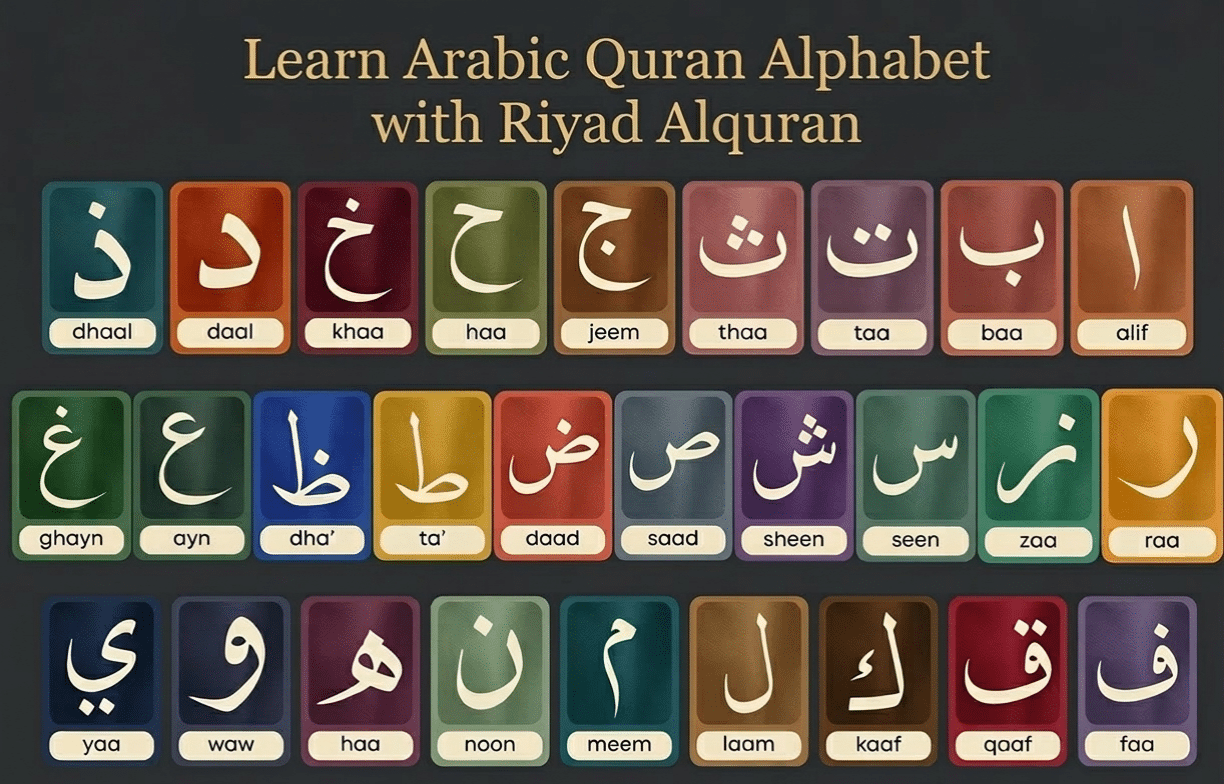
The Arabic Quran Alphabet consists of 28 essential letters read from right to left. Learning this Quranic Alphabet is the foundational step for any student, as it emphasizes the precise articulation (Makharij) of each sound from the throat or mouth. These letters are unique because they change their forms, initial, medial, or final based on their position in the Word.
Core Components of the Arabic Quran Alphabet for Quran:
- Arabic Letters and Sounds: Success begins with recognizing the 28 letters, from Alif (ا) to Yaa (ي), and understanding how dots (nuktat) completely change a letter’s sound.
- Diacritical Marks (Harakat): Using essential vowel marks like Fatha, Kasra, and Damma is vital for correct pronunciation.
- Specialized Marks: Students must learn the Sukoon (pause) and Shaddah (doubling) to read accurately.
- Word Structure: Practice focuses on connecting letters to form simple Quranic words, making it easier to start reading full verses.
- Tajweed Application: Many letters require specific timing, such as long vowels or Ghunnah, which are key to perfect recitation.
Essential Tips for Learners:
- Start with Phonetics: Focus on the sound of each letter before memorizing its shape.
- Use Interactive Tools: Tracing and flashcards are excellent for mastering letter forms.
- Find a Teacher: To avoid mistakes, it is best to learn from a qualified instructor at Riyad Alquran Institute.
- Daily Practice: Constant repetition of small portions strengthens your recognition and fluency.
Mastering Makharij: The Science of Arabic Sound Articulation
Mastering Makharij al-Huroof is the essential science of articulating letters from 17 precise points in the throat, tongue, and lips. This ensures an accurate Arabic quran alphabet pronunciation, which is vital for preserving the meaning of the Holy Quran. At Riyad Alquran Institute, we help students build the muscle memory needed to read Arabic alphabet correctly through these five main areas:
The 5 Main Articulation Areas:
- Al-Jawf (Oral Cavity): The space in the mouth and throat used for long vowel sounds (Madd letters). This is a key part of the Alphabet Quran Arabic for stretching sounds naturally.
- Al-Halq (Throat): This area produces deep, middle, and upper throat sounds (like ح and ع), which are unique to the Alphabet of Islam.
- Al-Lisaan (Tongue): The most detailed area, covering 18 letters. It includes the back (ق, ك), the center (ج, ش, ي), and the tip (ن, ر, ت, د, ط, ظ, ث, ذ) for clear speech.
- Al-Shafataan (Lips): You pronounce Ba (ب) and Meem (م) by closing your lips together, while the Fa (ف) is made by touching your upper teeth to your bottom lip. For the Waw (و), you just round your lips into a small circle to let the sound flow out correctly.
- Al-Khaishoom (Nasal Cavity): This produces the Ghunnah (nasal sound) for the letters Noon and Meem, adding beauty to your recitation.
Mastering Arabic Quran Alphabets: From Pronunciation to Writing with Riyad Alquran
The journey of a thousand miles begins with a single step, and for a Quran student, that step is mastering the Arabic Quran Alphabet. At Riyad Alquran Institute, we guide you through every stage from the moment you learn to pronounce a letter to the skill of connecting it into beautiful Quranic words.
1. Precision in Pronunciation and Phonology
To achieve a perfect Arabic letters pronunciation, you must understand how sounds are built:
- The 5 Articulation Areas: Sounds in the Quranic Alphabet originate from five specific areas: the throat, tongue, lips, oral cavity, and nasal cavity.
- Short Vowels (Diacritics): These small marks above or below letters, Fatha ( َ ), Kasra ( ِ ), and Damma ( ُ ), transform silent consonants into spoken words.
- Long Vowels (Madd): Three special letters, Alif (ا), Waw (و), and Ya (ي). They extend the short vowels into long ones.
- Special Consonants: We help you master the “shape-shifting” Hamza (ء) and challenging throat-based sounds like ‘Ayn (ع) and the unique Dhad (ض).
2. The Art of Writing and Letter Forms
Arabic is a beautiful, cursive language where Arabic Letters and Words flow from right to left.
- Four Positional Shapes: Each letter changes its look depending on whether it is Independent, Initial, Medial, or Final.
- Connectors vs. Non-Connectors: While most letters join together, six “rebel” lettersا, د, ذ, ر, ز, و never connect to the letter following them.
- Letter Groups & Dots: Many letters share the same base shape and are only distinguished by dots. For example:
- ب, ت, ث: Differentiated by the number and placement of dots.
- ج, ح, خ: The “Jim” family, where dots move from inside to top or disappear entirely.
- د/ذ and ر/ز: Pairs that look similar but produce very different sounds.
3. Essential Tips for Mastery
- Read with Harakat: Start by reading simple texts that include all vowel marks to reinforce your recognition skills.
- Visual Mnemonics: Use creative associations (like seeing Seen س as teeth or Ya ي as a duckling) to remember shapes.
- Handwriting Practice: Copying Quranic words helps solidify your understanding of how letters shift shapes in context.
- Expert Feedback: To truly Read Arabic alphabet correctly, practice with a qualified tutor at Riyad Alquran Institute who can correct your makhraj in real-time.
Essential Guide to Arabic Vowels: Fatha, Kasra, Damma, and Tanween
Understanding the Arabic Quran Alphabet in English is more than just knowing the shapes; it’s about mastering the marks that change their sounds. In any Al quran alphabet lesson, these marks (Harakat) are what transform a silent letter into a meaningful word.
1. The Three Short Vowels (Harakat):
These marks are the foundation for anyone looking for a high-quality Quran class:
- Fatha (ـَ ): A small diagonal line above the letter, adding a short “a” sound (e.g., بَ – Ba).
- Damma (ـُ ): A small comma-like mark above the letter, creating a short “u” sound (e.g., بُ – Bu).
- Kasra (ـِ): A small diagonal line below the letter, producing a short “i” sound (e.g., بِ – Bi).
2. Tanween (Double Vowels):
When studying the Arabic alphabet in Quran, you will notice the vowels doubling at the end of words. This is called Tanween, which adds an “-n” sound:
- Tanween al-Fatha (ـً ): Pronounced “-an”.
- Tanween al-Damma (ـٌ ): Pronounced “-un”.
- Tanween al-Kasra (ـٍ : Pronounced “-in”.
Why Accuracy Matters for the Arabic Quran Alphabet
Properly identifying these marks is crucial in the Arabic alphabet for quran learning. At Riyad Alquran Institute, we ensure you don’t just see the letters, but you hear the correct Arabic letters and sounds to maintain the integrity of the Quranic text.
A Comprehensive Arabic Quran Alphabet List for English Speakers
To Learn Arabic alphabet for quran, you need to look at each letter individually. Below is a detailed breakdown of the All letters in Arabic, showing how each sound translates to English to help you with the Quran letters with ease.
| The Letter | Name & Transliteration | Sound Approximation (English Examples) |
| ا | Alif | The open sound in Safari or the ‘a’ in Car. |
| ب | Baa | The explosive ‘b’ as heard in Bubble. |
| ت | Taa | The crisp ‘t’ at the start of Tea or Tiger. |
| ث | Thaa | The soft, airy ‘th’ as in Three or Thursday. |
| ج | Jeem | The sharp ‘j’ sound in Joy or Jungle. |
| ح | Haa | A deep ‘h’ like the breath you make to heat your hands. |
| خ | Khaa | A raspy ‘kh’ like the sound in the name Bach or Khan. |
| د | Daal | The clear ‘d ‘ sound at the beginning of Diamond. |
| ذ | Dhaal | The buzzy ‘th’ sound found in They or That. |
| ر | Raa | A vibrating ‘r’, similar to the flick of the tongue in Perro. |
| ز | Zay | The buzzing ‘z’ sound in Zone or Zoom. |
| س | Seen | The sharp ‘s’ hiss as in Sky or Seven. |
| ش | Sheen | The quiet ‘sh’ sound in Shadow or Shell. |
| ص | Saad | A heavy ‘s’ like a deeper, hollow version of Sore. |
| ض | Daad | A thick, resonant ‘d’ sound, try saying Dorm with a full mouth. |
| ط | Taa’ | A powerful, emphatic ‘t’ like the ‘t’ in Tall or Tough. |
| ظ | Zaa’ | A thick, buzzy ‘th’ sound, like a heavy version of This. |
| ع | ‘Ayn | A deep squeeze in the throat, no English match, but similar to a tight Ah. |
| غ | Ghayn | The “gargling” sound when you say the French word Rouge. |
| ف | Faa | A standard ‘f’ sound, as in Fast. |
| ق | Qaaf | A deep ‘k’ from the throat, like the ‘q’ in Qatar (not Kitten). |
| ك | Kaaf | The light, clicking ‘k’ sound in Key or King. |
| ل | Laam | The musical ‘l’ sound at the start of Light or Lemon. |
| م | Meem | The closed-lip ‘m’ sound in Magic or Music. |
| ن | Noon | The clear ‘n’ sound as in Night or No. |
| هـ | Haa’ | A faint, airy ‘h’ sound like a soft Hello or Heaven. |
| و | Waw | The rounded ‘w’ in World or the long ‘u’ in Blue. |
| ي | Yaa | The ‘y ‘ in Yellow or the long ‘e’ in Free. |
Understanding the Arabic Alphabet in English at Riyad Alquran Institute is your first step toward fluency. We focus on the Arabic quran alphabet pronunciation for each row above, ensuring you don’t just memorize shapes, but master the unique “Makhraj” (exit point) of every letter. By learning Arabic letters in writing with these fresh examples, you build a stronger, more accurate foundation for your Alphabet of Quran journey.
Ready to take your recitation to the next level? Understanding the letters is just the foundation. Proper Quranic flow comes from mastering the relationship between the letters. Explore our comprehensive guides on [Idgham Rules], [Izhar Letters], and [Ikhfa Meanings] to perfect your Tajweed today.
Why Join Riyad Alquran’s Online Arabic Language Course?
Choosing the right platform to master the Arabic Quran Alphabet is the first step toward a deeper connection with the Holy Book. At Riyad Alquran Institute, we provide a specialized learning experience that goes beyond simple letter recognition.
Our course is uniquely designed to focus on the precise articulation points (Makharij) of the Quran Alphabet. We ensure that every student, whether a child or an adult, learns the exact sound of each letter as it appears in the Divine text. By practicing with examples taken directly from the Quran, you build a strong foundation for Tajweed from day one.
Why choose us?
- Expert Tutors: Learn from native speakers who are certified in Tajweed and Arabic linguistics.
- Personalized Lessons: Our one-on-one sessions provide immediate feedback on your pronunciation.
- Modern Tools: We use interactive digital resources to make memorizing the Arabic Quran Alphabet engaging and effective.
- Flexible Learning: Our classes are designed to fit your busy schedule, ensuring a smooth and consistent learning journey.
Join Riyad Alquran Institute today to transform your reading skills and master the Arabic Quran Alphabet with confidence and accuracy.
Conclusion
Learning the Arabic Quran Alphabet is the first important step to reading the Holy Book correctly. It helps students feel more confident and connected to the words of Allah. At Riyad Alquran Institute, the goal is to make this journey easy and clear, helping every student understand the beauty of the Quran through simple and professional teaching.
Start Your Journey Today!
Ready to master the Holy Quran and Arabic Quran Alphabet? Choose the course that fits your goals and join Riyad Alquran Institute:
- Basic Quran Reading (Levels 1, 2 & 3)
- Tajweed-Al-Quran (Levels 1, 2 & 3)
- Classical Arabic (Levels 1 & 2)
- Quran Memorization (Hifz)
- Islamic Studies
[Register Now and Get 2 Free Trials!]
FAQs
How to pronounce Arabic alphabet correctly?
Pronouncing the letters correctly requires focusing on the “Makhraj,” which is the specific point in the throat or mouth where the sound originates. To achieve perfect accuracy, students should practice the Arabic Quran Alphabet by listening to native experts and imitating their articulation of guttural and emphatic sounds. Constant repetition and feedback from a qualified tutor are essential for mastering these unique phonetics.
Does Arabic have an alphabet?
Yes, Arabic has a unique alphabet known as the “Al-Abjadiyah,” which consists of 28 letters. Unlike Latin scripts, it is written from right to left and is entirely cursive. When you begin to study the Arabic Quran Alphabet, you will discover that it is primarily a consonantal system where vowels are added as small marks (diacritics) above or below the letters to guide the reader.
How is Arabic read?
Arabic is read from right to left, which is the opposite direction of English. The letters in a word are connected in a flowing, cursive style, and their shapes change depending on whether they appear at the beginning, middle, or end of a word. Learning to read the Arabic Quran Alphabet also involves recognizing these shifting forms and understanding how the short vowel marks (Harakat) dictate the flow of the sentence.
What are the Quran letters?
The Quran letters are the same 28 letters found in the standard Arabic alphabet, but they are often presented with specific Tajweed markings to ensure the sacred text is recited correctly. Each letter in the Arabic Quran Alphabet carries immense importance, as slight variations in pronunciation can change the meaning of a verse. Mastering these letters is the fundamental starting point for anyone looking to recite the Quran fluently.
How do you write in Arabic?
Writing in Arabic is an art form that involves connecting letters from right to left in a continuous script. Most letters connect to their neighbors on both sides, though six specific letters only connect to the right. When practicing the Arabic Quran Alphabet, beginners start by tracing individual letters in their four different shapes, isolated, initial, medial, and final to build the muscle memory needed for beautiful Arabic calligraphy.