
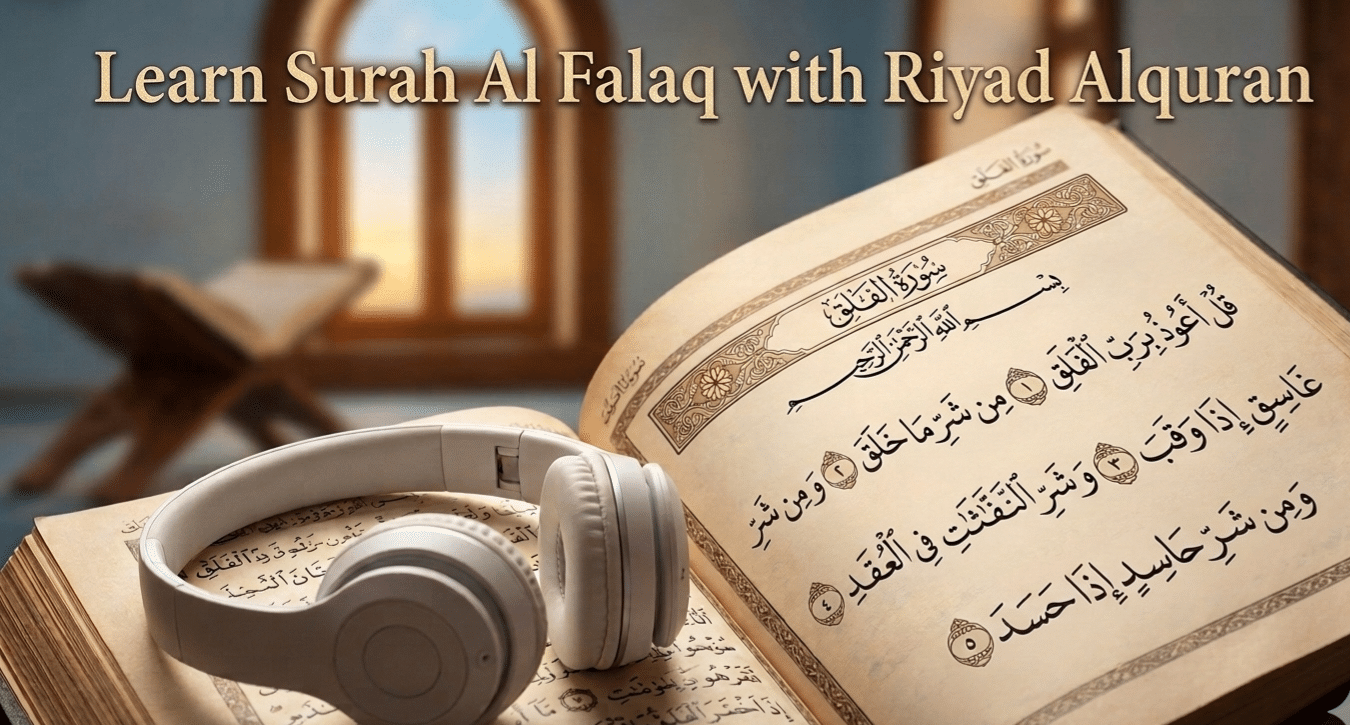
Have you ever wondered how five short verses can provide a total spiritual shield?
Surah Al Falaq, the Surah of Daybreak, is a divine gift revealed to protect us from the seen and unseen mischief of creation. At Riyad Alquran, we help you go beyond mere memorization to truly live the meanings of these powerful verses.
Our experienced Azhari teachers are here to guide you through its deep meanings and Tajweed rules. Whether you are a beginner or looking to refine your skills, exploring this Surah with us will bring peace and protection to your daily life.
Table of Contents
ToggleWhat is Surah Al Falaq about?
Surah Al Falaq, the 113th chapter of the Quran, comprises five verses that serve as a powerful prayer for protection. It instructs believers to seek refuge in Allah from various forms of harm, and many find that studying a detailed Surah Falaq tafsir helps in understanding its shield against the darkness of night and envy. It is often recited alongside Surah An-Nas for spiritual security, and for those learning, a Surah Al-Falaq guide is essential for daily practice.
Here are the main themes of Surah Al Falaq (also called Surah Falak or Sorah Falaq):
- Seeking Refuge: The surah begins by commanding believers to seek refuge in “the Lord of daybreak,” emphasizing turning to Allah for safety from all dangers.
- Specific Evils: It explicitly warns against the evil of creation, the darkness of night, and witchcraft (“those who blow on knots”).
- Envy: It highlights the malice of an envious person, a concept best understood through a clear Surah Al Falaq translation.
- Context: Known as Al-Mu’awwidhatayn (The Two Refuges), it was revealed to provide divine protection, and the Prophet Muhammad (ﷺ) used to recite it especially before sleeping.
Prophet Muhammad –peace and blessings be upon him– said: (Oh Ibn Abbas, should I tell you the best of what the seekers seek refuge with? I said: Yes, oh Messenger of God, he said: say: I seek refuge in the Lord of falaq and Say: I seek refuge in the Lord of people). This Hadith highlights the importance of the Sorah Falak as the best means for protection.
It is highly recommended to recite these verses in the morning and evening as a continuous protective measure.
Surah Al Falaq Translation and Transliteration
Reading Surah Al Falaq provides a divine shield against hidden harms, and many believers find that a clear Surah Falaq explanation helps them connect with its deep meanings. For those learning to recite, using a Surah Al Falaq transliteration alongside a reliable translation makes it easier to master this chapter, often searched by students as Surah Falk or Sorat Falak.
Surah Al Falaq in Arabic
بِسۡمِ ٱللَّهِ ٱلرَّحۡمَٰنِ ٱلرَّحِيمِ
- قُلۡ أَعُوذُ بِرَبِّ ٱلۡفَلَقِ
- مِن شَرِّ مَا خَلَقَ
- وَمِن شَرِّ غَاسِقٍ إِذَا وَقَبَ
- وَمِن شَرِّ ٱلنَّفَّـٰثَٰتِ فِي ٱلۡعُقَدِ
- وَمِن شَرِّ حَاسِدٍ إِذَا حَسَدَ
Surah Falaq transliteration
Bismillah hir rahman nir raheem
- Qul a’oozu bi rabbil-falaq
- Min sharri maa khalaq
- Wa min sharri ghaasiqin izaa waqab
- Wa min sharrin-naffaa-saati fil ‘uqad
- Wa min sharri haasidin izaa hasad
Surah Falaq translation (English)
In the name of Allah, the Entirely Merciful, the Especially Merciful
- Say, “I seek refuge in the Lord of daybreak
- From the evil of that which He created
- And from the evil of darkness when it settles
- And from the evil of the blowers in knots
- And from the evil of an envier when he envies.”
Detailed Interpretation (Tafsir) of Surah Al Falaq
Verse 1: “Say, I seek refuge with the Lord of the daybreak”
means say this to protect yourself. I seek refuge and resort to Allah and ask His Almighty to help. The Lord of Falaq: Falaq means the morning and light which guides the human to insight and not to be lost, and Falaq means also what splits up to give life, like the grains which split up to give a new plant. Whether we take the first meaning or the second one, the Lord who guides you and creates life is the one you should seek refuge in Him.
Verse 2: “From the evil of what He has created”
This is a general plea for protection from the harm of all created things. Whether you are studying this in a Sura Falaq lesson or reading it for protection, this verse covers evil from humans, jinns, animals, and any harmful creatures.
Verse 3: “And from the evil of the darkness when it settles”
because when it becomes dark at night, the man loses the ability to see anything and to defend himself against any danger. The intended here is not the night which comes after the day, but the long-deep darkness when it spreads out in the morning and blocks out the daylight; meaning, a misplaced darkness.
Verse 4: “And from the evil of those who blow on knots”
Regarding {And From the evil of those who puff in knots} and {And from the evil of the envious if he envies}, some rational scientists or people deny the presence of envy and sorcery. If we believe in God, our minds shouldn’t be evidence of what He had created; otherwise, what is the meaning of faith? Even with the use of the mind, your mind is a reason to accept there are things beyond your awareness. Ten centuries ago, if we told someone about Microbiology and microbes, would he understand? As sorcery and envy are beyond our awareness, no one can protect us but Allah, which is why they are specifically mentioned in Sura Falak.
Verse 5: “And from the evil of an envier when he envies”
The final verse provides protection from the destructive, jealous eye and the malicious actions of envious people. It teaches us to guard our blessings by seeking Allah’s protection from those who wish to see them taken away.
How to Recite Surah Al Falaq with Tajweed
Proper recitation of the Surah Al Falaq requires focusing on the correct articulation points (Makharij) and specific rules that ensure the beauty and accuracy of the verses. When you study Transliteration of Surah Falaq with Tajweed, you should pay close attention to the following areas:
Key Tajweed Rules for Surah Al Falaq
- Qalqalah (Echoing Sound): When pausing at the end of verses (1, 2, 3, 4, 5), letters like Qaf (ق) or Dal (د) must be pronounced with a slight echo or “bounce.”
- Examples: Al-falaq, Khalaq, Waqab, and Al-uqad.
- Ikhfa (Hidden Nasalization): In the phrase “Min sharri” (من شر), the Noon Sakinah (ن) is followed by the letter Sheen (ش), which requires a hidden, nasalized sound (Ghunnah).
- Shaddah (Emphasis): Letters with a Shaddah (ّ ) must be emphasized. In “An-Naffathati”, the letter Noon (ن) is held for 2 harakahs (counts) with a nasal sound.
- Madd (Elongation): In words like “Maa” (ما), the Madd Tabee’ee (normal elongation) should be held for exactly 2 counts.
- Izhar Halqi (Clear Pronunciation): When a Tanween is followed by the letter Hamza (أ) in “Ghasiqin Idha” and “Hasidin Idha”, the Tanween must be pronounced clearly without any extra nasalization.
- Al-Lam Al-Qamariyyah & Ash-Shamsiyyah: In “Al-Falaq”, the ‘Lam’ is pronounced clearly (Qamariyyah), whereas in “An-Naffathati”, the ‘Lam’ is silent and connects directly to the Noon (Shamsiyyah).
Step-by-Step Pronunciation Guide
- Qul a’udhu bi-rabbi l-falaq: Ensure the letter Thal (ذ) is pronounced softly by placing the tip of the tongue between the front teeth.
- Min sharri ma khalaq: The letter Ra (ر) in “Sharri” should be emphasized clearly.
- Wa min sharri ghasiqin idha waqab: The word “Ghasiqin” must begin with a clear, guttural Ghayn (غ).
- Wa min sharri n-naffathati fi l-uqad: The letter Tha (ث) in “Naffathati” requires a brief flow of breath, and the Noon has a strong Shaddah.
- Wa min sharri hasidin idha hasad: This final verse of the Sura Falaq ends with the word “Hasad,” requiring a strong Qalqalah on the letter Dal (د).
By consistently reciting this chapter, you ensure a powerful layer of spiritual protection in your daily life. We hope this guide and the provided Surah Al Falaq translation help you connect more deeply with the meanings of Surah Al Falaq in English.
Why Prophet Muhammad (PBUH) Recommended the Al-Mu’awwidhatayn.
Prophet Muhammad (ﷺ) emphasized the importance of the Al-Mu’awwidhatayn (Surah Al-Falaq and Surah An-Nas) as the most powerful, divinely revealed means of seeking refuge from all forms of physical and spiritual harm. These Surahs were specifically revealed to guard against the evil eye, magic, jinn, and whispers, replacing all other previous protective supplications. Many find that reading Al Falaq Surah in English helps in understanding this profound protection.
Key reasons why the Prophet (ﷺ) recommended Surah Al-Falaq and its companion include:
- Ultimate Protection: These chapters serve as a comprehensive shield against envy, harmful influences, and evil from both jinn and mankind.
- Sunnah Practice: It was the Prophet’s (ﷺ) habit to recite them every night, blowing into his hands and wiping his body before sleeping for divine security.
- Direct Supplication: By beginning with “Say, I seek refuge,” the Sura Falak acts as a direct prayer for protection against external dangers like darkness and envy.
- Daily Routine: Reciting them three times during the morning and evening is a prescribed Sunnah that provides continuous protection from all things.
Step-by-Step: Memorizing Surah Al-Falaq Easily at Home.
Memorizing the five verses of Surah Al Falaq is a simple and rewarding process. By listening to a professional reciter and repeating each ayah at least 10 times, you can easily integrate this powerful Surah into your daily Salah or before-bed routine. Understanding the Al Falaq Surah in English while you memorize will significantly improve your retention and connection to the verses.
Step-by-Step Memorization Guide
- Listen First: Start by listening to a reputable reciter multiple times to grasp the correct rhythm and Tajweed of the Sura Falak.
- The 10x Rule: Recite the first verse while looking at the Mushaf 10 times, then try to recite it from memory 10 times before moving to the next verse.
- Divide and Conquer: Since the Surah is short, break it down verse by verse. Only proceed to the next ayah once the current one is fluent.
- Combine and Connect: Once you have memorized the first two verses, recite them together 5 times before adding the third.
- Contextual Learning: Reading the translation of Sorah Falak helps you understand that these verses are a plea for protection, which makes the words much easier to remember.
Daily Routine to Lock it In
- Practice in Salah: Recite the newly memorized verses in your daily prayers to reinforce them.
- Morning/Evening Adhkar: Follow the Sunnah by reciting the Surah 3 times every morning and evening.
- Consistent Review: Review the entire Surah daily for at least a week to move it from short-term to long-term memory.
Key Tips for Success
- Seek Professional Guidance: While self-study is helpful, having a qualified teacher from a specialized institute like Riyad Alquran ensures your pronunciation and Tajweed are perfect from the start. A teacher provides the motivation and correction needed for long-term success.
- Use Visual Aids: Use a Quran app or a physical Mushaf to follow the text while listening to the audio.
- Consistency is Key: Short, focused daily sessions are much more effective than one long, exhausting session.
Common Mistakes to Avoid When Reciting Surah Al Falaq.
Even when reading the Al Falaq Surah in English or Arabic, many beginners fall into specific pronunciation errors. Avoiding these mistakes is crucial for a perfect recitation of Sura Falak.
How to Avoid Common Recitation Errors:
- Neglecting Shaddah on ‘Fa’ in “An-Naffathat”: In the fourth verse, the word An-Naffathat (النفاثات) contains a Shaddah on the letter Fa (ف). A common mistake is reciting it too quickly without holding the stressed consonant sound, which is essential for a correct recitation of Sorah Falak.
- Incorrect ‘Ayn’ Pronunciation: The letter Ayn in A’ūdhu (أَعُوذُ) must be articulated from the middle of the throat. Many mistakenly pronounce it as a sharp Hamza (A), which is incorrect in Tajweed.
- Missing Qalqalah (Echoing): The letter Dāl (د) at the end of the word Al-Hasad requires a slight “echoing” sound. Failing to apply this bounce results in a flat, abrupt stop that weakens the recitation’s beauty.
- Confusing ‘Qaf’ with ‘Kaf’: It is vital to ensure that Falaq ends with a deep, guttural Qaf (ق) rather than a light Kaf (ك). Distinguishing these sounds is essential when studying the Falaq Surah in English.
- Rushing the Recitation: Speeding through the verses often leads to skipping letters or ignoring mandatory Tajweed rules. A deliberate, calm pace is necessary for a spiritual and correct experience.
For the best results, ensure the final verses, which focus on protection from darkness and envy are pronounced with clarity and focus. Referencing a reliable Surah Al Falaq translation English can also help you understand the weight of each word, ensuring you don’t rush through the meanings.
In conclusion,
understanding the profound meanings and virtues of Surah Al Falaq empowers you to navigate daily challenges with spiritual confidence. These five verses serve as a timeless shield against envy and hidden mischief. At Riyad Alquran, we are dedicated to helping you live the beauty of the Quran through expert instruction and authentic Azhari guidance.
Ready to Master Surah Al Falaq?
Join Riyad Alquran today and take advantage of our Special Ramadan Offer:
- Free Trial: Register now and get your first lesson plus 2 free trials to experience our unique journey.
- Diverse Courses: Choose from Basic Quran Reading, Tajweed-Al-Quran, Classical Arabic, Memorization, or Islamic Studies.
- Expert Teachers: Learn from qualified graduates of Al-Azhar University holding Ijazah with a high-sanad.
- Family Plan: Siblings or a parent and child have special offers.
[Register Now to Start Your Journey!]
FAQs
1. Is Surah Al-Falaq Makki or Madani?
Surah Al Falaq is a Meccan (Makki) Surah. It was revealed during the early years of the Prophet Muhammad’s (ﷺ) mission in Makkah, focusing on building a strong spiritual connection with Allah and seeking His divine protection from all forms of evil.
2. What are Surah Falaq and Surah Naas called?
Together, these two Surahs are known as Al-Mu’awwidhatayn (The Two Refuges). They are called this because they both begin with the command “Say, I seek refuge,” and they serve as the primary chapters for seeking Allah’s protection from both physical and spiritual harm.
3. Why was Surah Al-Falaq revealed?
Surah Al Falaq was revealed to provide a divine spiritual defense following an incident where a magic spell was cast on the Prophet (ﷺ). The Surah serves as a remedy and protection against specific dangers like sorcery (magic), jealousy (envy), and the hidden evils that appear when darkness settles.
4. What is the meaning of Surah Al-Falaq?
The word Al-Falaq means “The Daybreak” or “The Dawn.” It refers to Allah as the “Lord of the Daybreak,” symbolizing how His protection brings light and safety to a person’s life, splitting through the “darkness” of fear and harm just as the sun splits the night.
5. What is Surah Al-Falaq about?
Surah Al Falaq is a comprehensive prayer for protection. It commands believers to seek refuge with Allah from four major evils: the general harm of all created things, the dangers of the night (Ghasiq), the malice of those who practice witchcraft (blowing on knots), and the destructive eye of an envier.