Have you ever wondered why Surah Al Ikhlas is considered equal to one-third of the Holy Quran? This short but powerful Surah holds the entire essence of faith in just four verses, making it a beautiful gateway for anyone starting their Quranic journey.
At Riyad Alquran Institute, we help you and your children realize these deep meanings through engaging, one-on-one sessions. Our Al-Azhar certified tutors are dedicated to making Tajweed easy and engaging, fitting perfectly into your family’s busy life. Join us today and take your first step toward mastering the words of Allah with confidence and ease.
Table of Contents
ToggleSurah Al-Ikhlas: Meaning, Definition, and Reasons for Revelation (Asbab al-Nuzul)
Surah Al Ikhlas is the 112th chapter of the Quran and a beautiful summary of Tawheed (the Oneness of Allah). Often called the “Chapter of Sincerity,” these four verses define the nature of God in the purest way.
Historically, Al Ikhlas Surah 112 was revealed in Makkah when a group of Jews asked Prophet Muhammad (PBUH) to describe his Lord. It serves as a powerful answer, rejecting any human-like attributes or the concept of Trinity.
Muslims cherish this Surah because reading Surah Al-Ikhlas 3 times is known to be spiritually rewarding, as the Prophet (PBUH) mentioned it is equal to one-third of the Quran in significance.
At Riyad Alquran Institute, we help students explore the Surah Al-Ikhlas tafseer to truly feel the weight of these words. Understanding why this Surah is a “Declaration of Purity” helps build a stronger connection with Allah during daily prayers and protection.
Surah Al- Ikhlas in English: Text and Transliteration
When we look at Surah Al Ikhlas, we find a clear and direct answer to those who questioned the Prophet (PBUH) about Allah. This Surah was revealed to settle the matter once and for all, declaring that Allah is One and absolutely Unique.
Surah Al-Ikhlas Arabic Text
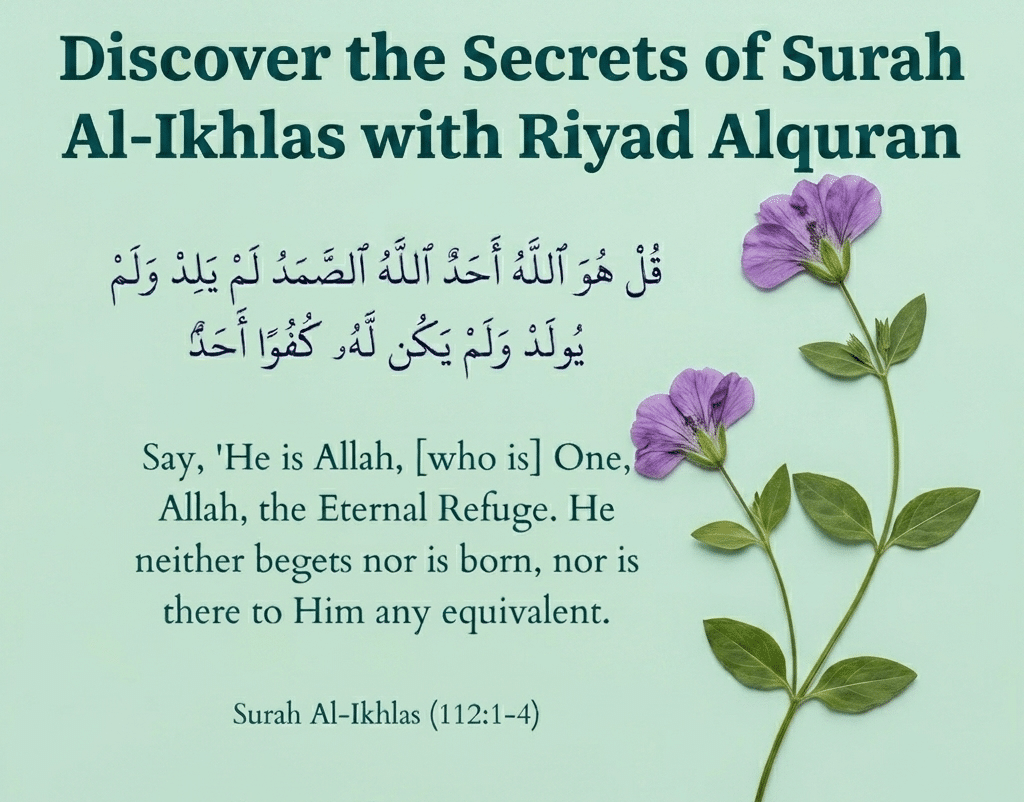
Before diving into the meanings, here is the Arabic original beautiful text of Surah Al-Ikhlas 112.
At Riyad Alquran Institute, we ensure our students learn to recognize these words clearly to build a strong foundation in Quranic reading:
بِسْمِ اللَّهِ الرَّحْمَٰنِ الرَّحِيمِ
١. قُلْ هُوَ اللَّهُ أَحَدٌ
٢. اللَّهُ الصَّمَدُ
٣. لَمْ يَلِدْ وَلَمْ يُولَدْ
٤. وَلَمْ يَكُن لَّهُ كُفُوًا أَحَدٌ
Surah Al-Ikhlas English Translation (Verse by Verse)
Understanding the Surah Al-Ikhlas translation English helps you feel the strength of faith in every prayer. Here is the breakdown of these four powerful verses:
- Verse 1: Say, “He is Allah, [who is] One.”
- Verse 2: “Allah, the Eternal Refuge.”
- Verse 3: “He neither begets nor is born.”
- Verse 4: “Nor is there to Him any equivalent.”
Surah Al-Ikhlas Transliteration for Easy Pronunciation
If you are still learning to read Arabic, using a Surah Al-Ikhlas transliteration is the perfect way to start reciting confidently. Our teachers use this method to help kids and beginners master the Surah Al-Ikhlas pronunciation guide quickly:
- Qul huwa Allahu ahad.
- Allahu assamad.
- Lam yalid walam yoolad.
- Walam yakun lahu kufuwan ahad.
By practicing with our Surah Al-Ikhlas transliteration, beginners can start reciting correctly even before they master Arabic.
Studying Surah Al-Ikhlas meaning is the first step we take with our students to help them feel the power of Tawhid in their daily prayers.
Through our one-on-one sessions, we ensure you pronounce every letter correctly while following the rules of Tajweed.
The Meaning and Tafseer of Surah 112 (Al-Ikhlas)
To truly live the message of Surah Al Ikhlas, let’s look at what each of its four verses teaches us about Allah. This is the simple approach we use at Riyad Alquran Institute to help even the youngest students connect with the Quran.
- Verse 1: “Say, He is Allah, [who is] One.” The word Ahad tells us that Allah is Unique. He has no partners, no equals, and nothing is like Him. It’s the ultimate statement of Tawheed.
- Verse 2: “Allah, the Eternal Refuge.” As we mentioned, Al-Samad means Allah is self-sufficient. Everyone needs Him, but He needs no one. He is the one you turn to for help with anything, big or small.
- Verse 3: “He neither begets nor is born.” This verse is very clear: Allah has no parents and no children. This part of Al Ikhlas Surah refutes the misconceptions of those who try to give Allah human-like family ties.
- Verse 4: “Nor is there to Him any equivalent.” The final verse of Ikhlas surah confirms that absolutely nothing in the universe, not even the most powerful things we can imagine, can ever be compared to Allah’s greatness.
Why is it Called “Al-Ikhlas Surah”?
The word “Ikhlas” means sincerity or purity. It is called this because the Surah is dedicated entirely to describing Allah, without mentioning anything else. When you recite it, you are purifying your faith from any Falsehoods and declaring your absolute sincerity to the One true God. It is the “Declaration of Purity” that every Muslim carries in their heart.
The Meaning of “Al-Samad”: Why We Need Allah and He Needs No One
In the second verse, we encounter the powerful name “Al-Samad”. This is one of the most important parts of the Surah Al-Ikhlas text.
- He Needs No One: Allah is perfectly self-sufficient. He doesn’t need food, sleep, or anyone’s help.
- We Need Him: At the same time, every single creature in the universe depends on Him for everything.
Through our Surah Al-Ikhlas translation and meaning sessions at Riyad Alquran Institute, we help you explore the beautiful names of Allah and how they apply to your life today.
The Power of Reciting Surah Al-Ikhlas with Al-Mu’awwidhatayn for Protection
Did you know that reciting Surah Al-Ikhlas 3 times along with Surah Al-Falaq and Surah An-Nas (known as the 3 Quls) acts as a complete protection for your home? These three short Surahs are gifts from Allah, meaning they are all you need to keep away harm, envy, and negative energy.
While Surah Al-Ikhlas recitation teaches us who Allah is, the Mu’awwidhatayn (Surah Al-Falaq and Surah An-Nas) teach us how to seek refuge in Him. Together, they create a perfect balance for a believer’s heart.
At Riyad Alquran Institute, we teach our students how to make these verses a part of their daily routine:
- Morning and Evening: Using the 3 Quls three times at dawn and dusk serves as a powerful shield against everything that might worry you throughout the day.
- A Peaceful Sleep: Following the Sunnah by reciting them before bed brings a sense of calm and safety to children and adults alike.
- Deepening Connection: One of the greatest Surah Al-Ikhlas benefits is how it reinforces our faith. By looking at the Surah Al-Ikhlas English translation, your recitation becomes a sincere prayer for peace.
Through our personalized Surah Al-Ikhlas tafseer sessions, our tutors at Riyad Alquran help you and your children master these daily Adhkar with perfect pronunciation and a deep, connected heart.
7 Life-Changing Surah Al-Ikhlas Benefits
Reciting this Surah is a simple way to gain immense spiritual rewards and feel closer to Allah. At Riyad Alquran Institute, we share these seven traditional benefits with our students to show how even the shortest verses can have a huge impact on your life:
- Equivalent to One-Third of the Quran: Reciting this chapter once provides the same reward as reading one-third of the Quran. This is why reading Surah Al-Ikhlas 3 times is a beloved daily habit for every Muslim.
- A Palace in Paradise: According to a beautiful Hadith, the Prophet (PBUH) promised that repeating these verses ten times results in Allah building a palace for you in Jannah, a reward that highlights the true Surah Al-Ikhlas benefits.
- Earning the Love of Allah: It is recorded in the Hadith that a companion used to recite this Surah in every prayer because he loved its description of Allah. When the Prophet (PBUH) heard this, he said: “Tell him that Allah loves him.” By exploring the Surah Al-Ikhlas meaning in English, you can build a similar connection with Allah’s attributes and earn His divine love and mercy.
- A Shield Against Harm: Using these verses as a protective barrier is a Sunnah. Mastering the Surah Al-Ikhlas benefits in English helps you recite these words of protection confidently every morning and evening.
- Bringing Abundance to Your Home: Consistent recitation when entering your house helps remove poverty. These verses remind the family of Allah’s role as the Provider (Al-Samad).
- Forgiveness of Sins: Scholars highlight that constant recitation helps wipe away minor sins.
- Strengthening Pure Faith: Daily reading and listening to Surah Al-Ikhlas audio regularly cleanses the heart of doubts and reinforces the concept of Tawheed (the Oneness of God) in everything we do.
At Riyad Alquran Institute, we believe that when you truly connect with the importance of Surah Al-Ikhlas, your daily recitation transforms from a habit into a deeply spiritual experience.
Master the art of Tajweed from the comfort of your home. With personalized plans and qualified tutors, reaching your Hifz goals is now easier than ever.
Why is Surah Al-Ikhlas Called the Sincerity of Faith?
While many know it as “The Sincerity,” the name Al-Ikhlas also means “Purity” or “Refining.” It acts like a filter for your faith, clearing away any fallacies about Allah. At Riyad Alquran Institute, we highlight how this Surah protects a believer’s heart in several ways:
- Purifying Your Belief: It removes any human-like qualities people might wrongly assign to Allah, keeping your concept of the Divine pure and clear.
- A Fortress Against Shirk: By declaring that Allah is uniquely One, Sureh Ikhlas serves as a shield against polytheism and the idea of Allah having partners or children.
- Refining Your Intentions: When you truly understand the Surah Al-Ikhlas text, it compels you to make your worship and intentions sincere for Allah alone.
This is the core meaning of Surah Al-Ikhlas 112 in English; it ensures your devotion is not mixed with any doubts. It is a definitive description of Allah that summarizes the very essence of Islam in just four verses.
Authentic Hadiths on the Virtues of Surah Al-Ikhlas
One of the most profound aspects of Surah Iklas is that it is deemed equal in reward to one-third of the Quran. This isn’t just a symbolic statement; it is a spiritual reality confirmed in Sahih Bukhari.
The Story Behind the Reward:
Abu Sa’id al-Khudri reported that a man once heard another reciting “Qul Huwa Allahu Ahad” repeatedly. Feeling that such a short Surah might be too simple, he informed the Prophet (ﷺ). The Prophet (ﷺ) responded with a powerful oath: “By Him in Whose Hand is my soul, it is equivalent to one-third of the Quran.” On another occasion, the Prophet (ﷺ) asked his companions if they could recite a third of the Quran in a single night. When they found this task difficult, he comforted them by explaining that reciting this specific Surah fulfills that immense reward.
Why is it a “Third”?
Scholars explain that the Quran’s message is divided into three main pillars: Islamic rulings, promises and threats (the hereafter), and the Names and Attributes of Allah. Because the Surah Al-Ikhlas text focuses entirely on the essence of Tawheed (the Oneness of Allah), it covers the third pillar perfectly.
A Sunnah for Protection: It was the Prophet’s (ﷺ) habit to recite this Surah along with the Mu’awwidhatayn (Al-Falaq and An-Nas) before sleeping, wiping his hands over his body to seek Allah’s protection.
By learning the Translation of Surah Al-Ikhlas, believers can truly appreciate why this “simple” Surah carries such weight of the Creator.
Conclusion,
Mastering Surah Al Ikhlas is more than just memorization; it’s about bringing the essence of Tawhid into your heart.
At Riyad Alquran Institute, we are ready to guide your family on this rewarding path with our expert Al-Azhar tutors. Don’t wait to start your journey! Register today to get your 2 free trials and experience Quranic learning like never before.
FAQs
Why does “did not give birth” come before “was not born” in the verses?
This order was revealed to address a specific point. Historically, some people claimed that God has a son, but no one ever claimed He had a father. Therefore, the verse prioritizes negating the idea of having offspring first to correct this common misconception and emphasize God’s perfection.
Why the Name “Al-Samad” Proves Allah’s Singularity?
The name “Al-Samad” refers to the Great Lord whom all creatures resort to and need, while He remains completely self-sufficient and independent of everyone. It also signifies that He does not need to eat or drink. This proves His singularity because only a unique and perfect being can be the ultimate refuge for all without having any needs Himself.
Why is Surah Al-Ikhlas Equivalent to One-Third of the Quran?
According to the narration in Sahih Al-Bukhari, the Prophet (PBUH) told his companions that this Surah equals a third of the Quran. This is because, despite being only four verses long, it summarizes the entire spirit of Islam, focusing purely on monotheism and devotion, which are the core foundations of the faith.
Why is it important to teach Surah Al-Ikhlas for kids at an early age?
Teaching Surah Al-Ikhlas for kids is the perfect way to introduce them to the beauty of Allah’s Oneness. Because the verses are short and rhythmic, children can easily memorize, while building a strong foundation of faith. At Riyad Alquran Institute, we focus on making these lessons fun and engaging, helping children understand that Allah is always there to protect and care for them.