
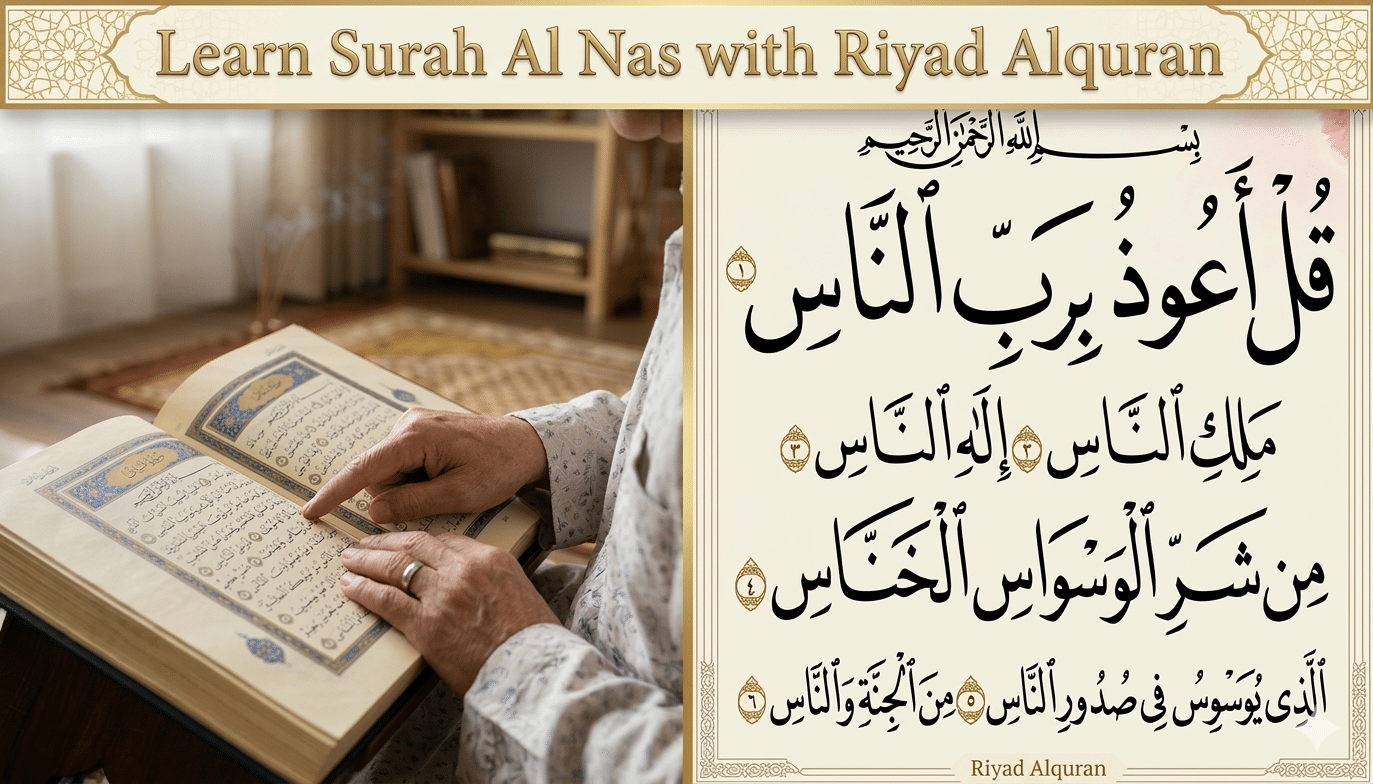
Exploring the profound meanings and spiritual protection offered by Surah al Nas is a transformative journey for every Muslim family seeking closeness to the Holy Qur’an. At Riyad Alquran Institute, we help students of all ages master the recitation and understanding of this essential chapter through expert-led online classes. Our Al-Azhar-graduated teachers ensure you grasp the Tajweed rules perfectly, fostering a deep connection with Allah’s words in every session. Whether you are a beginner or looking to refine your Tarteel, we provide a supportive environment to grow your faith starting today.
Table of Contents
ToggleSurah Al Nas: Key Facts & Reasons for Revelation
Surah al-Nas (Chapter 114) is the final chapter of the Qur’an, containing six verses that focus on seeking refuge in Allah from internal and external evils. Revealed alongside Surah Al-Falaq, it serves as a divine remedy against black magic and evil spiritual influences, forming a “triple shield” of Allah’s Lordship, Sovereignty, and Divinity.
Key Facts about Al Naas Surah:
- Significance: Known as one of the Mu’awwidhatayn (the two protective surahs).
- Meaning: “Surat al nas” means “The People” or “Mankind”.
- Structure: Six short, powerful verses focusing on Allah’s authority as Lord, King, and God of mankind.
- Usage: It is highly recommended to recite this Surah after every prayer, particularly for protection against the evil eye and Satanic influences.
Reasons of Revelation (Asbab al-Nuzul):
The revelation of Surah Al-Nas and Surah Al-Falaq is deeply connected to a challenging period in the life of Prophet Muhammad (ﷺ). Understanding this context helps us appreciate the immense protective power of these verses:
- Protection against Black Magic: The primary context is that Labid ibn al-A’sam, a man from the Jewish community in Madinah, performed magic on the Prophet (ﷺ) using a comb, some hair, and a string with eleven knots.
- The Prophet’s Distress: He (ﷺ) was so affected by this magic that he began to imagine doing things he had not actually done. This period of distress lasted for six months, during which he remained patient and turned to Allah in prayer.
- Divine Revelation: In response, Allah sent Angel Jibril with the verses of the Mu’awwidhatayn (totaling 11 verses, five in Al-Falaq and six in Al-Nas). Reading the English translation of Surah al Nas helps explain how these divine words acted as a direct remedy for the knots tied in the magic spell.
- Untying the Knots: As the Prophet (ﷺ) recited these Surahs, the knots were untied one by one with every verse. Once the final verse was recited, the magic was completely broken, and his health and strength returned as if he were “released from a shackle.
If you’re looking to master the recitation of these powerful surahs, you can join our online Quran classes. At Riyad Alquran Institute, we offer specialized sessions to help you understand the deeper meanings and Tajweed rules of the Holy Qur’an.
Surah Al Nas Arabic Text and Transliteration
Surah al Nas (Chapter 114) is the final chapter of the Quran, consisting of six verses, providing protection against evil whispers and temptations. It calls upon believers to seek refuge in Allah, the Lord, King, and God of humanity, forming a spiritual shield for the heart.
Surah al Nas Transliteration and Arabic Text
- قُلْ أَعُوذُ بِرَبِّ ٱلنَّاسِ (Qul a’oodhu birabbin-naas)
- مَلِكِ ٱلنَّاسِ (Malikin-naas)
- إِلَٰهِ ٱلنَّاسِ (Ilahin-naas)
- مِن شَرِّ ٱلْوَسْوَاسِ ٱلْخَنَّاسِ (Min sharril-waswaasil-khannaas)
- ٱلَّذِي يُوَسْوِسُ فِي صُدُورِ ٱلنَّاسِ (Alladhee yuwaswisu fee sudoorin-naas)
- مِنَ ٱلْجِنَّةِ وَٱلنَّاسِ (Minal-jinnati wannaas)
Key Themes and Benefits of An Nas Surah
- Protection: Sura al Nas is primarily used to seek refuge in Allah from spiritual, mental, and external evil whispers (Waswasa).
- Significance: It is part of the “Qul” surahs used for daily safety from Shaytan. Understanding the Surah al nas interpretation helps believers grasp how it addresses malicious influences.
- Creator’s Attributes: Surah alnas mentions three main attributes of Allah: Rabb (Lord), Malik (King), and Ilah (God).
At Riyad Alquran Institute, we offer specialized programs to help you and your family master the Holy Quran and Surah al Nas in English with expert guidance.
Surah Al Nas English Translation and Meaning
As the 114th and final revelation, this Makki Surah provides a profound spiritual conclusion to the Holy Book. Through its 6 verses, it establishes a direct plea to Allah by His supreme attributes, Lord, King, and God of mankind to shield the heart from hidden temptations. Unlike other chapters that address physical harm, its primary focus is safeguarding the soul from the subtle whispers that originate from both Jinn and human influences.
Surah al Nas English translation
- Say, “I seek refuge in the Lord of mankind,”
- “The King of mankind,”
- “The God of mankind,”
- “From the evil of the whisperer who withdraws,”
- “Who whispers in the hearts of mankind,”
- “Among jinn and among mankind.”
Meaning and Tafsir of Surat al Nas
- Seeking Protection: The Surah Nas opens by acknowledging Allah as the Lord, King, and God of all people, highlighting His total sovereignty as the protector.
- The Whisperer (Shaytan): The “sneaking whisperer” refers to the devil (Shaytan) or his aides who put evil thoughts and doubts into people’s hearts, as we explained in Surah al Nas translation.
- Withdraws: In Sura nas, we learn that the devil whispers when a person is distracted but hides (withdraws) when a person remembers Allah.
- Sources of Evil: This Al Naas chapter emphasizes that evil influences can come from both Jinns (unseen entities) and other human beings.
Begin your journey of understanding the Holy Book by exploring the Surah al Nas in English translation with our dedicated experts. At Riyad Alquran Institute, we strive to make every lesson a transformative step toward spiritual excellence.
The Virtues and Benefits of Reciting Surah Al Nas
Surah al Nas is a powerful Makki surah, forming the final part of the “Mu’awwidhatayn” (The Two Protectors) along with Surah Al-Falaq. It offers comprehensive protection from internal evils, specifically whispers in the heart, Satanic influences, and jinn, while bringing peace and strengthening faith.
Virtues and Benefits of Reciting Al Nas Surah:
- Ultimate Protection: Reciting this Surah, especially in combination with Al-Falaq and Al-Ikhlas, acts as a shield against Shaytan, magic, the evil eye, and jealousy.
- Protection at Night: The Prophet Muhammad (ﷺ) used to blow into his hands and wipe over his body before sleeping after reciting Surah al nas english, Surah Al-Falaq, and Surah Al-Ikhlas to stay safe from evil.
- Morning/Evening Adhkar: It is highly recommended to recite it in the morning and evening to ensure protection throughout the day.
- Internal Peace: It serves as a remedy for anxiety and fear by focusing on seeking refuge in Allah, as highlighted in the Al Nas Surah translation.
- Warding Off Shaytanic Whispers: It targets the “whisperer” (waswasa) who instills negative thoughts, providing spiritual solace and inner security.
- Revival of Sunnah: Reciting Surat an naas when ill, or during daily prayers, is a confirmed Sunnah.
As stated in the Hadith, these last two Surahs in the Quran are the most beloved to Allah for seeking protection.
While Al-Nas focuses on internal whispers, Surat Al-Falaq addresses external harms, making them the perfect duo for comprehensive safety.
Tajweed Rules for Surah Al Nas: A Comprehensive Pronunciation Guide
Tajweed for Surah al Nas requires focusing on Shaddah (holding Noon for 2 counts), clear pronunciation of Makharij, and light/heavy letter distinction. Key rules for Surat an naas include strict Ghunnah (nasal sound) on the ّن, maintaining consistent Madd (2 counts), and ensuring proper Waqf (pauses) at the end of verses.
Key Tajweed Rules and Pronunciation in Al Naas Surah
- Ghunnah (Noon Shaddah): The most important rule in Sura al Nas is holding the sound for two harakat (vowel counts) on the noon with a shaddah:
- بِرَبِّ النَّاسِ (Birabbin-nās): The nās must have a clear 2-count nasal sound.
- مَلِكِ النَّاسِ (Malikin-nās): Same rule applied.
- إِلَهِ النَّاسِ (Ilāhin-nās): Same rule applied.
- مِنَ الْجِنَّةِ وَالنَّاسِ (Minal-jinnati wan-nās): Twice in the final verse.
- Madd (Lengthening):
- An-Nās (النَّاسِ): The alif should be lengthened (2 vowel counts), and the end seen must be clear after pausing.
- Al-Khannās (الْخَنَّاسِ): Same lengthening rule applies.
- Makharij (Articulations) & Pronunciation:
- ذ (Thal): In A’udhu (أَعُوذُ), the tip of the tongue touches the front teeth, sounding like “th” in “that”.
- ص (Ṣād): In Ṣudūr (صُدُورِ), the letter is heavy (Tafkheem).
- س (Seen): In Waswās (وَسْوَاسِ), the seen is a light, thin letter.
- خ (Kha): In Al-Khannās (الْخَنَّاسِ), this is a heavy, throaty letter.
- Ikhfā (Hidden sound):
- مِن شَرِّ (Min sharri): The noon is followed by a shīn, requiring a hidden, nasal sound as detailed in our Surah al Nas interpretation.
Pronunciation Guide by Verse
- Qul a’ūdhu birabbin-nās (Pronounce “dh” with tongue between teeth, hold nās).
- Malikin-nās (Hold nās).
- Ilāhin-nās (Hold nās).
- Min sharril-waswāsil-khannās (Hidden noon sound, make kh heavy).
- Alladhī yuwaswisu fī ṣudūrin-nās (Heavy ṣ, light s, hold nās).
- Minal-jinnati wan-nās (Hold n in jinnati and nās).
Mastering these rules ensures your recitation is both beautiful and accurate according to the Surah al Nas English translation of sound. At Riyad Alquran Institute, we offer personalized feedback to help you perfect your Tajweed and connect more deeply with the Holy Quran.
The Connection Between Surah Al Falaq and Surah Al Nas
Surah Al-Nas (114) and Surah Al-Falaq (113), known together as Al-Mu’awwidhatayn (The Two Protectors), are closely linked as a pair revealed to protect against all forms of evil. While Al-Falaq shields against external threats, Surah Al-Nas acts as a combined shield against internal whispers, sorcery, and malicious actions from both Jinn and humans.
Key Connections and Similarities in the Mu’awwidhatayn
- The Two Protectors: They are often recited together in morning and evening Adhkar to provide comprehensive safety and spiritual peace.
- Context of Revelation: They were revealed jointly as a divine cure for the Prophet Muhammad (ﷺ), providing the spiritual remedy needed to untie the knots of magic and envy.
- Complementary Protection:
- Surah Al-Falaq focuses on seeking refuge from external evils like darkness and jealousy.
- Surah Al-Nas focuses on internal evils, such as spiritual diseases and whispers in the heart.
- Similar Structure: Both begin with a direct command to seek refuge in Allah, the Master of all creation, identifying the danger and asking for divine protection.
Together, they offer total spiritual security, addressing both external calamities and inner temptations.
Understanding these deep connections helps you recite with more presence and devotion. At Riyad Alquran Institute, we guide you through the meanings and secrets of the Holy Book, providing a clear Surat al nas english perspective to strengthen your faith and protection.
Conclusion
The spiritual essence and protective nature of Surah al nas remain a fundamental pillar for every Muslim seeking peace and divine guidance. At Riyad Alquran Institute, the focus is on mastering this chapter’s recitation and profound meanings through specialized guidance. Understanding its verses deeply allows the Holy Qur’an to become a constant source of strength and tranquility in our daily lives.
Master Tajweed with Al-Azhar-certified experts.
Join the Riyad Alquran family today and experience an enjoyable, high-quality learning journey. Click here to book your free trial.
FAQs
What is the meaning of surah al nas?
Surah Al-Nas, the 114th and final chapter of the Quran, translates to “The Mankind.” Its primary meaning revolves around seeking absolute refuge in Allah, the Lord, King, and God of mankind from the “Waswas” (whisperer). It addresses the subtle, hidden evils that affect the heart, such as doubts, temptations, and negative thoughts planted by both Jinn and humans.
How to memorize surah al nas?
Since it is a short surah with rhythmic verses, memorizing it is accessible for all ages. The best method is to listen to a professional Qari to ensure correct Tajweed, then repeat each verse individually. Focus on the ending sound “Nās” which repeats in every verse, making it easier to follow the flow. Dividing it into two parts (seeking refuge in Allah’s attributes vs. identifying the evil) can also speed up the process.
What are the benefits of surah al nas?
This Surah offers immense spiritual benefits, primarily serving as a shield against the “evil eye,” magic, and Satanic whispers. Along with Surah Al-Falaq, it was revealed as a divine cure and protection. Reciting it before sleep, as practiced by the Prophet Muhammad (ﷺ), ensures safety throughout the night, while its regular recitation brings inner peace and protects the heart from spiritual diseases like anxiety and doubt.
Where to find surah al nas english translation?
You can easily find a reliable Al Nas Surah in English translation on popular websites like Quran.com or in famous books like Sahih International. These translations help you understand the meaning of seeking Allah’s protection in simple English. At Riyad Alquran Institute, we also provide interpreted translations to help students connect the meanings with their daily lives.
What is the 114 surah in quran?
The 114th Surah in the Quran is Surah Al-Nas. It holds a unique position as the concluding chapter of the Holy Book, completing the “Mu’awwidhatayn” (The Two Protectors). Being a Makki surah, it focuses on the fundamental relationship between the Creator and the created, ending the Quranic revelation with a powerful plea for divine protection from all internal and spiritual harms.